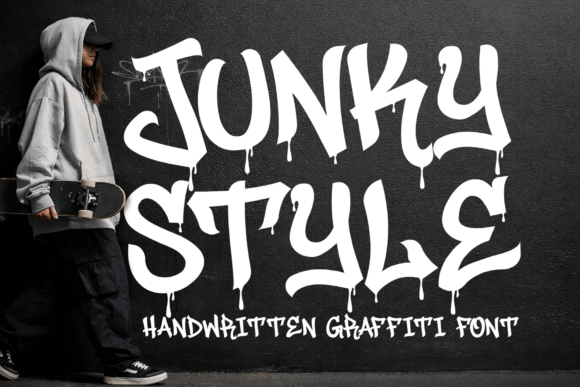
Junky Style: Strategic Application of Raw Urban Typography in Modern Branding
In the crowded landscape of digital design and independent branding, legibility often takes precedence over personality. However, specific market segments demand a visual language that communicates authenticity, rebellion, and raw energy before a single word is read. Junky Style serves this precise strategic function. It is not merely a decorative asset; it is a high-contrast, handwritten display font engineered to replicate the aggressive stroke and paint-drip terminals of fresh marker tags. For entrepreneurs, marketers, and creators operating within streetwear, extreme sports, underground music, or youth-centric subcultures, selecting this typeface is a deliberate positioning decision rather than an aesthetic afterthought.
Understanding the utility of Junky Style requires moving beyond its visual appearance to analyze its semiotic weight. The font’s chaotic flow and thick, uneven strokes signal immediacy and human intervention. In an era of polished, AI-generated perfection and sterile corporate minimalism, these imperfections act as trust signals for audiences who value grassroots authenticity. When integrated into a broader design system, Junky Style functions as a primary attention mechanism, anchoring social media headers, event posters, and product packaging with a visceral impact that standard sans-serifs cannot achieve. The strategic value lies in its ability to instantly categorize a brand within the urban hierarchy, filtering out mismatched demographics while deeply resonating with the intended core audience.
Aligning Typography with Subcultural Positioning
The decision to implement Junky Style should stem from a clear understanding of brand identity and target demographic psychographics. This typeface carries significant cultural baggage; it references graffiti culture, skateboarding, punk zines, and hip-hop history. Consequently, it is most effective when the brand’s operations, voice, and product offering align with these roots. Using such a distinctively rebellious font for a conservative financial service or a luxury spa would create cognitive dissonance, damaging credibility rather than enhancing it.
For independent streetwear labels, Junky Style supports the narrative of exclusivity and counter-culture status. The font mimics the ephemeral nature of street art, suggesting that the brand exists outside mainstream commercial channels even if it operates within them. Similarly, for extreme sports graphics, the aggressive terminals and rhythmic chaos mirror the kinetic energy and risk inherent in the activity itself. In these contexts, the typography does not just label the content; it embodies the experience. Marketers must evaluate whether their brand possesses the "street capital" to wield this aesthetic authentically. If the connection is tenuous, the design will be perceived as appropriation rather than appreciation, leading to audience alienation.
Hierarchy and Functional Legibility
A common failure point in using display fonts like Junky Style is the neglect of information hierarchy. While the font excels at capturing attention, its intricate details and variable baseline make it unsuitable for body copy or complex data presentation. Strategic application demands restraint. Treat Junky Style as a headline instrument or a focal point element, never as a workhorse for extended reading.
- Headlines and Hooks: Reserve the font for primary messages where emotional impact outweighs the need for rapid scanning. Short phrases, single words, or impactful statements allow the paint-drip terminals to breathe without creating visual mud.
- Social Media Headers: On platforms like Instagram, TikTok, or YouTube, profile banners serve as digital billboards. Junky Style provides the necessary contrast to stop the scroll, but ensure critical text remains within safe zones and maintains readability on mobile devices.
- Merchandise and Apparel: When printing on fabric, consider how the ink spread might interact with the font’s already distressed edges. Test prints are essential to ensure the aggressive strokes do not bleed into illegibility on textured materials.
- Pairing Strategy: Balance the chaos of Junky Style with neutral, highly legible typefaces. A clean geometric sans-serif or a monospaced utility font creates a tension that makes the display font pop while ensuring functional information remains accessible.
Operational Considerations for Digital and Print Media
Beyond aesthetic alignment, practical execution determines the long-term success of using specialized typography. Junky Style’s high-contrast weight and detailed terminals present specific technical challenges across different media. Decision-makers must account for these variables during the planning phase to avoid costly rework or inconsistent brand experiences.
In digital environments, screen resolution and rendering engines can struggle with the fine details of paint drips and rough edges. What looks crisp on a high-resolution design mockup may appear pixelated or aliased on lower-end mobile screens. It is advisable to test the font at various sizes and across multiple devices before finalizing web assets. For responsive design, establish breakpoints where Junky Style scales appropriately or switches to a simpler alternative if the viewport becomes too narrow to sustain legibility.
Print production introduces physical constraints. The ink density required for the thick strokes differs significantly from the negative space created by the drip effects. When designing for large-format posters or banners, verify that the printer’s RIP software handles the complex vector paths correctly. Conversely, in small-format applications like business cards or clothing tags, the intricate details may fill in due to ink spread. Establishing minimum size guidelines in your brand style guide prevents misuse and ensures the font retains its intended character regardless of the application.
Risk Assessment and Contextual Awareness
Every strong design choice carries inherent risks. The primary danger with Junky Style is unintentional stereotyping or trivialization of the culture it references. Audiences within urban and street communities are highly literate in these visual codes and quick to identify inauthenticity. Brands that adopt the aesthetic without engaging with the community, supporting relevant causes, or understanding the history risk being labeled as opportunistic.
Furthermore, there is the risk of visual fatigue. Because the font is so visually loud, overuse diminishes its impact. If every touchpoint screams with aggressive typography, the audience becomes desensitized, and the brand loses its ability to emphasize key messages. Strategic variety is essential. Use Junky Style to punctuate campaigns or highlight seasonal drops, but allow quieter moments in the visual identity to provide contrast. This ebb and flow keeps the aesthetic fresh and maintains its power as a signaling device.
Accessibility is another non-negotiable consideration. Display fonts with irregular baselines and decorative elements often fail WCAG standards for text contrast and readability. Never use Junky Style for navigation menus, legal disclaimers, pricing tables, or instructional text. Its role is atmospheric and emphatic, not functional. Ensuring that accessibility compliance is maintained through proper pairing and semantic HTML structure protects the brand from exclusionary practices while preserving the desired aesthetic edge.
Long-Term Value and Brand Evolution
Trends in street culture move rapidly, but foundational aesthetics often possess longer lifecycles when applied with intention. Junky Style offers durability because it is rooted in the enduring practice of tagging and hand-lettering rather than fleeting digital trends. However, brands must remain agile. Regularly audit how the font performs against evolving platform algorithms, changing audience sentiments, and new competitors entering the space.
Consider the font as part of a living system rather than a static logo lockup. As the brand matures, the application of Junky Style might shift from overt dominance to subtle accentuation, reflecting growth and sophistication while retaining core identity markers. Documenting usage rules, approved pairings, and prohibited applications in a comprehensive brand guideline ensures consistency across teams and external partners. This operational discipline transforms a stylistic preference into a scalable asset.
Ultimately, the effectiveness of Junky Style depends on the clarity of the strategy behind it. It is a powerful tool for communicating raw energy and urban authenticity, but only when wielded with respect for its origins and precision in its execution. By focusing on alignment, hierarchy, technical viability, and cultural integrity, creators and business owners can leverage this typeface to build distinctive, resonant brands that stand the test of both time and trend cycles. The goal is not just to look rebellious, but to communicate with a level of conviction that earns lasting engagement from a discerning audience.