Gemonk: Strategic Application of Unconventional Display Typography
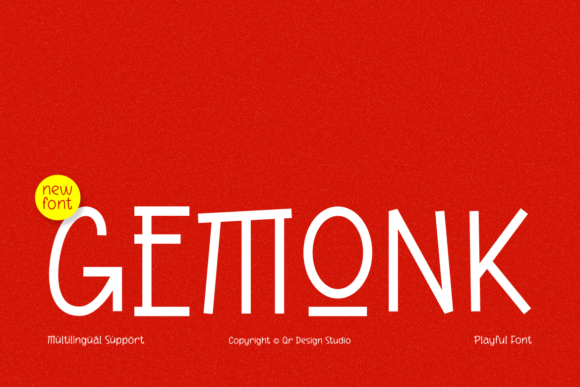
In the crowded landscape of visual communication, distinctiveness is not merely an aesthetic preference; it is a business imperative. Gemonk represents a strategic departure from safe, standardized typography, offering designers and brand strategists a tool to disrupt visual monotony. This hand-drawn sans-serif typeface is defined by its rejection of rigid typographic rules, utilizing primitive geometry, varying stem heights, and striking baseline shifts to create a personality that feels both ancient and urgently modern. For entrepreneurs, marketers, and creative directors, understanding Gemonk requires looking beyond its playful surface to evaluate its capacity for signaling brand values, capturing attention in saturated markets, and establishing a memorable visual identity.
The typeface operates on an architectural framework that blends stylized tribal curves with exaggerated crossbars and underlined circular characters. This combination generates a rhythmic pulse reminiscent of modern cave art or runic inscriptions. However, the decision to implement such a visually loud typeface must be grounded in clear objectives. Gemonk is not a universal solution for legibility; it is a specialized instrument for emotional resonance and differentiation. When deployed intentionally, it transforms text from mere information delivery into a tactile brand experience, particularly effective for alternative streetwear, indie music festivals, artisanal packaging, and edgy editorial content.
Aligning Typographic Rebellion with Brand Positioning
Choosing Gemonk is effectively a positioning statement. In a market where clean, neo-grotesque sans-serifs often signal corporate stability and neutrality, Gemonk signals authenticity, raw creativity, and human imperfection. For small business owners and freelancers targeting niche audiences, this distinction is valuable. The font’s irregularities suggest a hands-on approach and a willingness to break conventions, which can build immediate rapport with demographics that value individuality over mass production.
However, alignment requires honesty. If your brand promise relies on precision, luxury minimalism, or institutional trust, Gemonk may introduce cognitive dissonance that harms rather than helps. The typeface works best when the product or service itself possesses an element of craft, rebellion, or organic complexity. For example, an artisanal hot sauce brand benefits from the primitive geometry because it reinforces the idea of small-batch, handmade quality. Conversely, a fintech startup using this typeface might inadvertently signal instability. Before adoption, audit your brand pillars against the font’s inherent characteristics to ensure the visual language supports, rather than contradicts, your core message.
Strategic Use Cases and Contextual Fit
To maximize return on design investment, apply Gemonk in high-impact, low-density environments where its eccentric charm can function as a hook rather than a barrier. The following contexts offer the highest strategic value:
- Alternative Streetwear Branding: Fashion relies on subcultural signaling. Gemonk’s baseline shifts and tribal curves resonate with street culture’s appreciation for remixing historical aesthetics. Use it for garment tags, chest prints, or campaign headers to distinguish your line from competitors using standard bold sans-serifs.
- Creative Event Collateral: Indie music festivals and art fairs compete for attention in dense visual feeds. The font’s rhythmic, runic quality creates texture that stands out in social media thumbnails and physical posters, suggesting an immersive, non-corporate experience.
- Artisanal Product Packaging: On shelf or screen, packaging must communicate value instantly. Gemonk adds perceived craftsmanship to labels for coffee, craft beer, ceramics, or boutique cosmetics, justifying premium pricing through visual association with handmade goods.
- Editorial and Book Design: For quirky book titles, zines, or blog headers, the typeface sets a tone of voice before the reader processes a single word. It prepares the audience for unconventional narratives or experimental content.
- Social Media Headlines: In feed-based environments, stopping the scroll is the primary metric. Gemonk’s unique silhouette acts as a pattern interrupt, but reserve it for short, punchy statements where legibility remains intact at mobile sizes.
Navigating Legibility and Hierarchy Risks
The most significant risk associated with expressive display fonts like Gemonk is the sacrifice of utility for style. Because the typeface relies on varying stem heights and baseline shifts, extended reading becomes fatiguing. Strategically, this means Gemonk should almost never be used for body copy, captions, or functional UI elements. Its role is strictly hierarchical: it is the headline, the logo lockup, or the accent, never the workhorse.
Designers must also consider accessibility. The decorative nature of the letterforms can reduce contrast and character recognition for users with visual impairments or dyslexia. To mitigate this, pair Gemonk with a highly legible, neutral sans-serif or serif for supporting text. Ensure sufficient color contrast between the typeface and its background, avoiding busy textures behind the already complex letterforms. Testing across devices is mandatory; what reads clearly on a 27-inch monitor may become illegible noise on a smartphone screen. If the message cannot be deciphered in under two seconds, the aesthetic choice has failed its communicative purpose.
Planning for Long-Term Visual Consistency
Trend-driven typography carries the risk of rapid obsolescence. While Gemonk currently taps into a desire for raw, human-centric design, relying on it too heavily can date your brand assets. To future-proof your investment, treat Gemonk as a seasoning rather than the main ingredient. Develop a flexible design system where the typeface is one component of a broader visual identity that includes color, photography style, layout grids, and secondary typography.
Create usage guidelines that define exactly when and how Gemonk appears. Specify maximum character counts, acceptable background treatments, and mandatory pairing fonts. This prevents scope creep where enthusiastic team members begin applying the display font to email signatures or invoice templates, diluting its impact and creating operational inconsistency. By codifying its use, you maintain the font’s power as a special occasion tool rather than allowing it to become visual wallpaper.
Enhancing Customer Experience Through Intentional Design
Beyond aesthetics, typography influences how customers feel about interacting with a brand. Gemonk’s hand-drawn quality introduces warmth and approachability that polished digital fonts often lack. In customer experience (CX) terms, this can lower psychological barriers and foster a sense of community. For educators, coaches, or community organizers, using this typeface in welcome materials or event signage can signal inclusivity and creativity, making participants feel they are entering a space that values expression over perfection.
However, intentionality is key to positive CX. Using an eccentric font in contexts requiring clarity—such as pricing tables, safety instructions, or checkout flows—creates friction that damages trust. Map the customer journey and identify touchpoints where emotional connection outweighs functional necessity. Apply Gemonk at those moments of delight and discovery, while maintaining rigorous standards of clarity elsewhere. This balanced approach ensures the typeface enhances the user experience without compromising usability.
Making the Decision: A Practical Checklist
Before integrating Gemonk into your next project, evaluate the decision against these practical criteria to ensure strategic soundness:
- Audience Resonance: Does your target demographic value novelty and craftsmanship over tradition and uniformity? Test mockups with representative users to gauge reaction.
- Content Volume: Is the intended application limited to short-form display text? If you need more than three lines of text, reconsider or drastically increase leading and tracking.
- Brand Alignment: Does the primitive, rebellious aesthetic support your specific value proposition, or does it merely look interesting? Avoid adopting trends that lack narrative justification.
- Technical Viability: Have you tested rendering across all intended platforms? Verify that baseline shifts do not cause clipping in CMS templates or social media overlays.
- Pairing Strategy: Do you have a complementary typeface selected that provides necessary contrast and readability? Never let Gemonk stand alone in a layout without a stabilizing partner.
Ultimately, Gemonk serves as a powerful differentiator for brands willing to embrace calculated risk. Its value lies not in its novelty, but in its ability to communicate specific human qualities—imperfection, rhythm, and raw energy—that sterile typography cannot replicate. By approaching this typeface with strategic discipline rather than decorative impulse, creators can harness its eccentric charm to build identities that are not only visually striking but deeply resonant with their intended audiences. The goal is never to use a font because it is unique, but because its uniqueness solves a specific communication challenge in ways that conventional options cannot.