Adrik: Strategic Application of Liquid Motion in Visual Branding
In the crowded landscape of digital and physical media, typography serves as the primary vehicle for brand personality. While clean sans-serifs dominate corporate communication for their neutrality, there are strategic moments when neutrality fails to capture attention or convey energy. Adrik represents a specific solution to this challenge. It is a drip display font that introduces liquid motion into static headlines, offering a bold alternative to standard typographic hierarchies. For entrepreneurs, marketers, and creative directors, understanding Adrik requires looking beyond its aesthetic novelty. The typeface must be evaluated as a functional asset capable of influencing perception, guiding user attention, and reinforcing niche positioning.
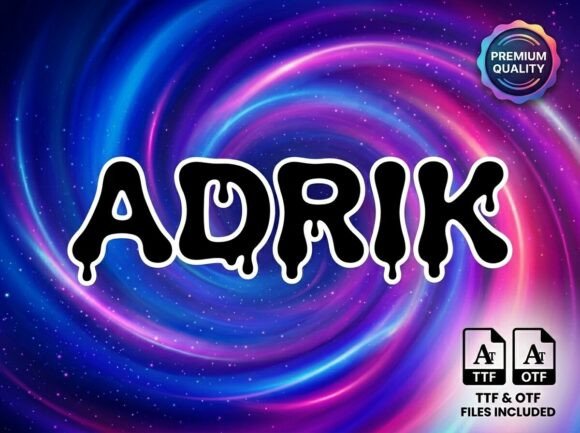
Adrik is characterized by heavy, rounded letterforms with gravity-defying drips that melt from the baseline. This creates a high-impact visual of fluid movement that feels both handcrafted and professionally executed. However, the decision to implement such a distinct typeface should never be arbitrary. It requires a clear alignment between the visual weight of the font and the strategic objectives of the project. When used intentionally, Adrik transforms from a decorative element into a communication tool that signals energy, rebellion, and tactile quality.
Evaluating Brand Fit and Market Positioning
Before integrating Adrik into a design system, stakeholders must assess whether the typeface aligns with their market positioning. Typography carries semantic meaning; users decode fonts before they read words. Adrik’s thick silhouette and smooth, polished contours communicate specific attributes: informality, dynamism, and sensory engagement. These traits make it an extraordinary choice for specific verticals but potentially detrimental to others.
Consider the following strategic alignments where Adrik delivers measurable value:
- Streetwear and Apparel: In fashion, typography often acts as the primary graphic element. Adrik’s eccentricity supports brands that rely on hype culture and limited drops. The melting aesthetic suggests exclusivity and counter-culture relevance, distinguishing merchandise from mass-market alternatives.
- Edgy Music and Entertainment: For concert posters, album art, and festival branding, legibility at a distance is paramount. Adrik’s heavy weight ensures readability while the liquid motion conveys the auditory experience of bass and rhythm. It bridges the gap between visual art and sonic identity.
- Gaming and Esports: High-energy gaming headers require typefaces that feel active even when static. The downward flow of Adrik mimics kinetic energy, supporting interfaces and promotional materials that need to retain user focus in fast-paced environments.
- Snack Food and Beverage Packaging: On retail shelves, packaging competes for split-second attention. The "drip" motif triggers subconscious associations with freshness, flavor, and indulgence. Adrik’s rounded forms appear approachable and tasty, making it ideal for products targeting younger demographics or impulse buyers.
If your brand operates in sectors requiring high trust, stability, or clinical precision—such as finance, healthcare, or legal services—Adrik likely introduces cognitive dissonance. The risk here is not just aesthetic mismatch, but a degradation of perceived competence. Strategic use means knowing when not to use a tool as much as knowing when to deploy it.
Balancing Eccentricity with Operational Clarity
A common pitfall in adopting display fonts is prioritizing style over function. Adrik delivers a sense of handcrafted eccentricity, but professional power comes from restraint. To achieve long-term results, designers and marketers must treat Adrik as a specialized instrument rather than a universal solution.
Hierarchy and Legibility Management
The intricate details of Adrik’s melting baseline can become visual noise if misapplied. Strategic planning involves establishing strict usage guidelines to maintain operational clarity across touchpoints.
- Reserve for Headlines Only: Adrik is engineered for impact at large sizes. Using it for subheads, body copy, or UI elements destroys legibility and dilutes its power. Limit application to H1s, hero banners, and primary call-to-action buttons.
- Pair with Neutral Counterparts: To prevent visual fatigue, pair Adrik with highly legible geometric sans-serifs or monospaced fonts. The contrast amplifies Adrik’s unique characteristics while ensuring essential information remains accessible. This balance supports better user experience (UX) and reduces bounce rates caused by poor readability.
- Mind the Negative Space: The dripping elements extend below the baseline, affecting line height and spacing. Designers must account for this vertical footprint during layout planning to avoid overlapping text or cramped compositions. Proper whitespace management preserves the "polished contours" that give Adrik its professional finish.
- Test Across Mediums: A font that looks dynamic on a 4K monitor may fail on a mobile screen or embroidered patch. Conduct cross-platform testing early in the production cycle. If the drips merge at small sizes, establish minimum size thresholds in your brand guidelines to protect integrity.
Risk Assessment and Decision-Making Framework
Adopting a distinctive typeface like Adrik involves inherent risks. Without clear goals, the font can appear gimmicky or dated. Decision-makers should apply a practical framework to validate the choice before full-scale implementation.
Audience Resonance vs. Trend Fatigue: Display fonts often ride waves of popularity. Ask whether Adrik appeals to your core audience’s enduring preferences or merely current trends. For a seasonal campaign or product launch, trend alignment is acceptable. For a decade-long rebrand, ensure the typeface has enough structural substance to age gracefully. Adrik’s smooth, polished contours offer more longevity than rougher grunge styles, but validation through audience testing is prudent.
Contextual Appropriateness: Consider the environment where the type will live. A dripping font on a luxury spa website creates confusion; on a hot sauce label, it creates appetite. Context dictates meaning. Review all planned applications against the emotional response you intend to elicit. If the goal is reassurance, Adrik is likely wrong. If the goal is excitement, disruption, or sensory stimulation, it is strategically sound.
Licensing and Scalability: Practical operations include verifying licensing terms for commercial use, web embedding, and app integration. Ensure the license covers all intended channels to avoid legal exposure or costly mid-project pivots. Additionally, confirm that the font file includes necessary language support and OpenType features to maintain consistency across global markets.
Integrating Adrik into Long-Term Creative Strategy
Typography is not merely decoration; it is infrastructure. When integrated thoughtfully, Adrik supports broader business goals by creating a memorable visual anchor. Consistency builds recognition, and recognition drives conversion. However, consistency does not mean monotony.
To maximize long-term value, develop a flexible system around the typeface. Create templates that define exactly how Adrik interacts with photography, color palettes, and negative space. Document these rules to streamline workflows for freelancers, agencies, and internal teams. This operational discipline ensures that every use of Adrik reinforces brand equity rather than eroding it through inconsistent application.
Furthermore, measure performance. In digital contexts, A/B test headlines set in Adrik against control variants. Does the liquid motion increase click-through rates? Does it improve time-on-page for entertainment content? Data validates intuition. If metrics show improved engagement, the investment is justified. If performance stagnates, revisit the hierarchy or pairing strategy. Strategic design is iterative, not static.
For educators and content creators, Adrik offers a case study in visual rhetoric. Use it to teach principles of contrast, mood, and audience adaptation. Demonstrating how a single typeface can shift perception helps students and junior designers understand that font selection is a business decision with tangible outcomes.
Making the Final Selection Decision
Choosing Adrik should be a deliberate act of differentiation. It is best suited for projects where standing out is more valuable than blending in. Its legendary personality demands confidence from the brand wielding it. When aligned with clear objectives, supported by rigorous usability standards, and deployed with operational discipline, Adrik transcends its role as a display font. It becomes a strategic asset that communicates energy, craftsmanship, and bold intent.
Ultimately, the effectiveness of Adrik depends less on the font itself and more on the intentionality of its user. Avoid random application. Respect its visual weight. Plan for legibility. Test for resonance. By approaching Adrik with the same rigor applied to marketing strategy or product development, professionals can harness its liquid motion to create work that is not only visually striking but commercially effective and enduringly relevant.