Victory Outline: Leveraging Bold Athletic Typography for High-Impact Visual Communication
The Psychology of Geometric Strength in Sports Branding
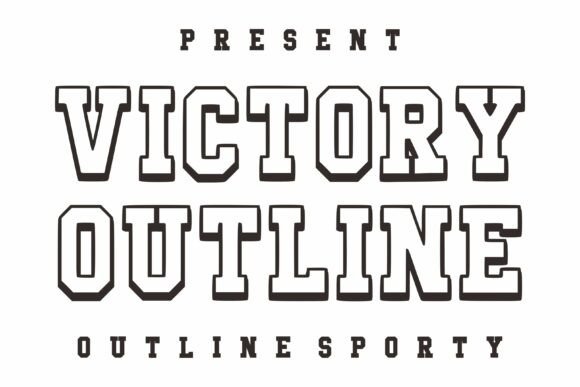
Typography in the athletic sector serves a function far beyond mere legibility; it acts as a visual proxy for physical performance, team identity, and competitive spirit. When designers select a typeface for sports-related projects, they are not simply choosing letterforms but are actively shaping the emotional response of the audience. Victory Outline operates within this specific psychological framework by utilizing clean outline strokes and block-style geometry to evoke feelings of power, stability, and forward momentum. The decision to use an outlined display font rather than a solid fill is strategic. Outlined typography reduces visual weight while maintaining structural mass, allowing for high visibility without overwhelming background imagery or complex photographic compositions.
This balance is critical in modern sports marketing where dynamic photography often competes with textual information. The bold, energetic nature of Victory Outline ensures that headlines remain readable against busy textures like grass, turf, or crowd shots. Furthermore, the all-caps structure inherent to this typeface reinforces a sense of authority and uniformity. In semiotics, uppercase block letters are associated with institutional strength and unwavering confidence. By adopting these characteristics, brands can subconsciously communicate professionalism and elite status to consumers, fans, and stakeholders before a single word of copy is processed cognitively.
Structural Anatomy and Design Versatility
Understanding the technical construction of Victory Outline reveals why it performs effectively across diverse media. The font is built on a clean geometric structure, meaning the curves and angles adhere to mathematical precision rather than organic calligraphy. This geometric foundation provides several practical advantages for designers working in both digital and print environments. First, the uniform stroke width ensures consistent reproduction quality whether the type is scaled down for a social media graphic or enlarged for stadium signage. Second, the negative space created by the outline style allows for creative layering techniques that are difficult to achieve with solid fonts.
- Layering Capabilities: The hollow center permits the integration of team colors, gradients, or texture overlays directly within the letterforms without requiring complex masking.
- Scalability: Vector-based geometric outlines maintain crisp edges at extreme sizes, preventing the pixelation or blurring common in rasterized athletic fonts.
- Visual Rhythm: The consistent spacing and block proportions create a steady visual cadence that guides the eye efficiently across headlines and merchandise.
- Modern Adaptation: While rooted in traditional varsity aesthetics, the clean lines prevent the design from appearing dated or nostalgic, keeping the brand relevant to contemporary audiences.
These structural attributes make the typeface a versatile tool for professionals who need to maintain brand consistency across disparate touchpoints. A logo designed using Victory Outline will retain its integrity when embroidered on a cap, printed on a polyester jersey, or displayed as a watermark on video content. This adaptability is essential for comprehensive branding systems where the visual identity must survive translation across various manufacturing processes and screen resolutions.
Practical Applications Across Merchandise and Digital Media
The true value of any display font lies in its application. For Victory Outline, the primary use cases extend well beyond simple headlines. In the realm of merchandise and apparel, this typeface addresses specific production challenges. Screen printing and heat transfer vinyl applications benefit significantly from outlined lettering because there is less surface area for adhesive or ink. This reduces the risk of peeling, cracking, or heavy fabric hand-feel, which are common complaints with large, solid block letters on athletic wear. Designers creating team jerseys or fan gear can utilize the bold presence of the font to maximize impact while minimizing material usage and production costs.
In digital environments, the font serves as an anchor for user interface elements and social media assets. Content creators and social media managers often struggle to make text pop against video backgrounds or action shots. The high contrast provided by the outline style creates natural separation from the background image. When used in Instagram stories, YouTube thumbnails, or TikTok overlays, Victory Outline commands attention during rapid scrolling. Its sporty athletic feel aligns perfectly with short-form video content trends, where immediate visual recognition is paramount. Additionally, web designers can employ this typeface for hero sections on landing pages, pairing it with minimalist sans-serif body text to create a hierarchy that emphasizes key messages without sacrificing readability.
Navigating Licensing and Technical Implementation
While the aesthetic qualities of Victory Outline are compelling, successful implementation requires attention to technical and legal considerations. Professionals and business owners must verify licensing terms before deploying the font in commercial projects. Display fonts often have different licensing tiers for personal use, desktop publishing, web embedding, and app usage. Ensuring compliance protects organizations from potential legal issues and supports the type designers who create these valuable assets. From a technical standpoint, users should be aware that all-caps display fonts require careful tracking adjustments. Because Victory Outline features bold geometric forms, default spacing may appear too tight or too loose depending on the specific word combination.
Manual kerning is often necessary to achieve optical balance, particularly with adjacent characters that have conflicting shapes. Designers should also consider accessibility standards when using outlined typography. While excellent for headlines, low-contrast outlines can be difficult for visually impaired users to read. It is best practice to reserve Victory Outline for large-scale decorative purposes and pair it with highly legible, solid body fonts for essential information. Furthermore, when preparing files for print, designers must ensure that outlines are converted to curves or that the font is properly embedded to prevent substitution errors at the print shop. Understanding these workflow nuances distinguishes amateur designs from professional-grade deliverables.
Strategic Pairing and Hierarchy Management
A typeface as dominant as Victory Outline cannot exist in isolation. Effective graphic design relies on the interplay between contrasting elements to establish clear information hierarchy. Because this font possesses such a strong personality, it demands supporting typefaces that provide stability without competing for attention. Pairing strategies should focus on neutrality and readability. Clean, geometric sans-serifs or humanist typefaces often work best as companions, echoing the modern structure of Victory Outline while offering the legibility required for subheads, captions, and body copy.
- Establish Dominance: Use Victory Outline exclusively for primary headers, logos, and call-to-action buttons to preserve its impact.
- Create Contrast: Select secondary fonts with lighter weights and open counters to offset the heavy, enclosed nature of the display font.
- Maintain Alignment: Utilize grid systems to align the bold geometric edges of the headline with the structured baseline of the body text.
- Limit Usage: Restrict the font to short phrases or single words; extended paragraphs in outlined caps cause significant cognitive fatigue.
Educators and researchers studying visual communication can observe how these pairing choices influence information retention. When the headline captures attention through athletic boldness and the body text facilitates easy reading, the overall message is absorbed more efficiently. Business owners applying these principles to marketing collateral will find that their materials not only look more professional but also perform better in terms of engagement metrics. The goal is always to serve the content; Victory Outline provides the energy, but thoughtful typographic system design ensures that energy is directed purposefully toward the intended audience.
Cultural Relevance and Future-Proofing Athletic Design
Trends in sports design cycle rapidly, moving between retro nostalgia and futuristic minimalism. Victory Outline occupies a unique position that bridges these eras. Its block-style letterforms pay homage to classic collegiate athletics and mid-century industrial signage, yet the clean execution feels distinctly modern. This temporal flexibility makes it a safer investment for long-term branding initiatives compared to hyper-trendy distressed or grunge fonts that may look outdated within a few seasons. Organizations building a new visual identity or refreshing an existing one should consider this longevity factor.
Moreover, the rise of esports and digital fitness platforms has expanded the definition of "athletic" typography. These sectors require visuals that translate well to screens and streaming interfaces. The geometric clarity of Victory Outline renders exceptionally well on RGB displays, making it suitable for gaming teams, fitness apps, and virtual event branding. As the boundaries between traditional sports and digital entertainment continue to blur, versatile typefaces that function across physical and virtual spaces become increasingly valuable. By understanding the broader cultural context and technical requirements of modern athletics, designers and stakeholders can leverage Victory Outline not just as a stylistic choice, but as a strategic asset in building resilient, recognizable brands.