Salem: Evaluating a High-Impact Display Font for Dark Aesthetics
In the crowded landscape of display typography, finding a typeface that balances historical weight with contemporary readability is a persistent challenge for designers. Salem enters this space as a specialized tool for projects requiring an atmosphere of arcane mystery and primeval strength. Unlike generic blackletter revivals or standard horror fonts that often sacrifice legibility for shock value, Salem offers a refined, high-impact aesthetic rooted in artisanal craft. For professionals working in publishing, branding, and entertainment, understanding the specific utility and limitations of this typeface is essential before integrating it into a visual identity system.
Defining the Visual Character and Texture
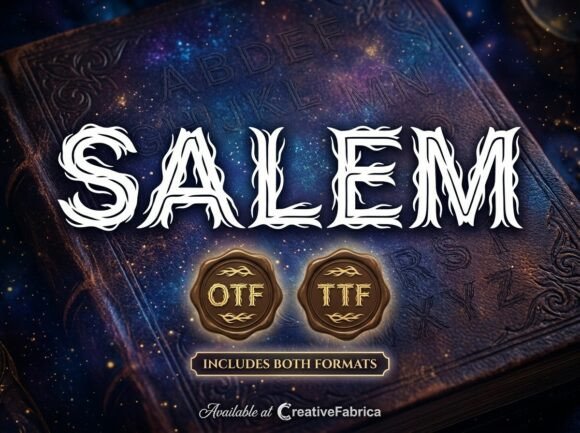
Salem is best categorized as a modern interpretation of blackletter-influenced display type, but its distinction lies in its internal texture. Where traditional gothic fonts rely on rigid, uniform strokes, Salem incorporates a rhythmic, whispering quality within the letterforms. This textural detail mimics organic movement, evoking associations with smoke, creeping vines, or weathered parchment. This is not merely a decorative overlay; it is integrated into the vector structure of the font, ensuring that the texture remains crisp at large sizes and does not pixelate or blur during print production.
The visual weight of Salem is massive. It commands attention through sheer density rather than excessive width. The terminals are sharp and ornate, providing a sense of historical prestige that feels authentic rather than costumey. This balance allows the font to function effectively in contexts ranging from period-accurate book covers to modern streetwear logos. The design avoids the cartoonish exaggeration found in lower-quality novelty fonts, maintaining a level of sophistication required for professional commercial work.
Practical Applications and Industry Fit
Evaluating Salem requires looking beyond its aesthetic appeal to its functional performance in real-world scenarios. Based on its construction and stylistic cues, the typeface demonstrates particular strength in four key areas:
- Horror and Dark Fantasy Publishing: Book covers in these genres must communicate tone instantly on a thumbnail-sized digital shelf. Salem’s bold silhouette ensures readability at small scales while the intricate texture rewards closer inspection on physical copies. It pairs exceptionally well with minimalist illustration or photography-heavy layouts where the title needs to anchor the composition.
- Mystical and Alternative Branding: For businesses in the tarot, apothecary, occult, or alternative wellness spaces, Salem provides immediate semiotic signaling. It communicates "handcrafted" and "ancient" without appearing amateurish. The font’s artisanal beauty suggests a brand that values tradition and depth over mass-market trends.
- Cinematic and Event Titling: In motion graphics or static posters, the high contrast and ornate terminals of Salem create natural focal points. The internal texture adds visual interest during slow pans or zooms in video content, preventing the text from appearing flat against dark backgrounds.
- Streetwear and Apparel Graphics: The edgy, unyielding nature of the letterforms translates well to merchandise. Salem works effectively as a standalone logotype or combined with illustrative elements. Its density allows for strong ink coverage on textiles, making it reliable for screen printing and embroidery digitization.
Technical Usability and Workflow Considerations
A beautiful display font is useless if it creates friction in the design workflow. Salem’s construction suggests several technical considerations for professionals. First, the complex internal texture increases the node count of each glyph. While this ensures quality, designers should be mindful of file size when using Salem in web environments or complex vector illustrations. Rasterizing the type at the final output resolution is often preferable to keeping it as live text in resource-heavy compositions to maintain software performance.
Kerning and spacing require active management with this typeface. Due to the irregular, organic edges of the letterforms, automatic tracking settings may result in uneven visual gaps. Manual optical kerning is necessary to achieve a cohesive wordmark, particularly when setting titles in all-caps. The sharp terminals can create unintended negative space traps; adjusting the spacing to create a consistent rhythm across the headline is part of the intended usage process.
Legibility is the primary constraint. Salem is strictly a display face. It performs optimally between 48pt and 120pt depending on the medium. Below 36pt, the internal texture begins to merge, reducing clarity and creating visual noise. Designers should never use Salem for body copy, captions, or subheads. It functions as a singular voice in a typographic hierarchy and must be supported by highly legible sans-serif or serif companions for secondary information.
Pairing Strategies and Hierarchical Balance
Because Salem carries such significant visual gravity, pairing it requires restraint. The goal is to support the display face without competing with it. Effective combinations typically involve:
- Geometric Sans-Serifs: Clean, neutral faces like Futura, Avant Garde, or Montserrat provide necessary contrast. Their mathematical precision offsets Salem’s organic irregularity, grounding the design in modernity.
- Transitional Serifs: For a more classical or academic feel, transitional serifs like Baskerville or Caslon bridge the gap between Salem’s archaic forms and contemporary readability. This combination works particularly well for editorial design and non-fiction books exploring historical mysteries.
- Monospaced Typefaces: In streetwear or tech-adjacent mystical branding, pairing Salem with a monospace font creates a compelling tension between the ancient and the mechanical. This juxtaposition signals a fusion of tradition and innovation.
Avoid pairing Salem with other blackletters, scripts, or highly textured display fonts. Such combinations create visual vibration and confuse the hierarchy. Let Salem serve as the sole decorative element in the typographic system.
Assessing Long-Term Value and Versatility
When investing in a premium display typeface, professionals must consider longevity. Trend-dependent novelty fonts often have a shelf life of one to two seasons before appearing dated. Salem mitigates this risk through its foundation in historical calligraphy. While the texture is stylized, the underlying bone structure references centuries of typographic tradition. This gives the font a timeless quality that transcends fleeting design fads.
The versatility of Salem extends beyond pure horror applications. Its association with "arcane mystery" is broad enough to encompass luxury goods, heritage brands, music festivals, and artisanal food packaging. A winery, for example, could utilize Salem to evoke old-world viticulture without implying supernatural themes. A metal band and a boutique tea shop might both find valid use cases for the same typeface, demonstrating its range across disparate markets.
However, users should recognize the boundaries of this versatility. Salem is inherently serious and intense. It is unsuitable for children’s media, corporate finance, healthcare, or any context requiring approachability and softness. Attempting to force Salem into lighthearted or clinical contexts will result in tonal dissonance that undermines the message. Understanding what the font cannot do is as important as recognizing its strengths.
Final Evaluation for Creative Professionals
Salem represents a high-value asset for designers who frequently work within dark, mystical, or heritage aesthetics. Its combination of massive visual weight, intricate textural detail, and historical resonance solves specific communication problems that generic fonts cannot address. The typeface delivers a sense of handcrafted authority that elevates headlines from mere labels to integral components of the narrative experience.
For freelancers and agencies building a library of reliable tools, Salem justifies its place through specialization. It is not a workhorse for everyday layout but a precision instrument for moments requiring legendary presence. When used with appropriate spacing, proper hierarchical support, and respect for its legibility thresholds, Salem transforms visual identities with an unforgettable, atmospheric impact. Professionals evaluating this typeface should test it against their specific project requirements, ensuring the tone aligns with their audience’s expectations and the medium’s technical constraints. In the right hands, Salem is less of a decorative choice and more of a strategic storytelling device.