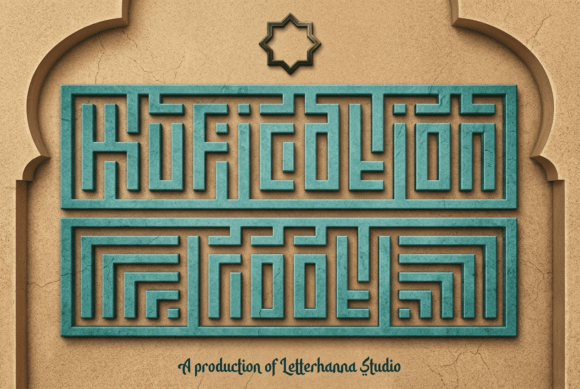
Kufication Root: Bridging Arabic Geometric Tradition and Modern Latin Typography
The Architectural Logic Behind the Letterforms
In the vast landscape of contemporary typography, few typefaces manage to balance historical reverence with modern utility as effectively as Kufication Root. This display font is not merely a stylistic experiment; it is a structural translation of one of the most significant scripts in Islamic visual history. To understand why this typeface commands attention, one must first understand its foundation: Square Kufic calligraphy. Unlike fluid cursive scripts that prioritize speed and connectivity, Square Kufic (or Banna'i) was originally designed for architectural surfaces. It is inherently modular, constructed on a strict grid system where positive and negative space hold equal importance.
Kufication Root adopts this ancient angular logic and applies it to the Latin alphabet. The result is a typeface that feels less like traditional handwriting and more like masonry or digital pixel art. Every glyph is built upon a rigorous geometric framework, ensuring that the weight distribution remains consistent across the entire character set. For designers and brand strategists, this means the font carries an intrinsic sense of stability and permanence. It does not flow; it stands. This architectural quality makes it uniquely suited for projects requiring a visual voice that is both authoritative and culturally resonant, distinguishing it from standard geometric sans-serifs that often lack such specific historical grounding.
Differentiation Through Structural Authenticity
A common pitfall in cross-cultural typography is superficial imitation. Many fonts attempt to evoke an "Eastern" or "Islamic" aesthetic by simply adding decorative flourishes to standard Latin shapes. Kufication Root avoids this orientalist trap by borrowing proportions rather than decoration. The differentiation lies in its skeletal structure. The aspect ratio, the stroke thickness, and the termination points of the letters are derived directly from centuries-old calligraphic rules.
This authenticity provides a tangible advantage for heritage projects and Islamic branding. When used in these contexts, the typeface communicates respect and accuracy rather than caricature. For a broader audience, including commercial advertisers and product designers, this structural integrity translates into high legibility at large sizes and a distinctive texture that breaks the monotony of conventional corporate typography. It serves as a bridge, allowing non-Arabic speaking audiences to engage with the aesthetic principles of Islamic art through the familiarity of Latin characters.
Strategic Applications in Visual Identity
The bold, blocky nature of Kufication Root dictates specific use cases where its strengths can be fully realized. Because it is a display font, it is optimized for impact rather than extended reading. Understanding where to deploy this typeface is crucial for maintaining readability and design harmony.
Logos and Brand Marks
The primary strength of Kufication Root lies in logotype design. The grid-based construction allows for seamless locking of letters, creating wordmarks that function almost as icons. In brand identity systems, this modularity offers flexibility; individual letters can be extracted to serve as monograms or app icons without losing their structural integrity. For businesses operating within the MENA region or those targeting Muslim consumers globally, using this font signals cultural alignment without sacrificing international accessibility. It creates a brand asset that feels indigenous to the culture yet universally legible.
Packaging and Product Labels
On physical products, typography must compete for attention amidst visual clutter. The heavy visual weight of Kufication Root makes it exceptionally effective for packaging headers and labels. Whether applied to luxury goods, artisanal food products, or cultural artifacts, the font conveys a sense of craftsmanship and premium quality. Its geometric precision suggests manufacturing exactness, while its calligraphic roots imply tradition. This duality is particularly valuable for brands attempting to position themselves as "modern heritage," bridging the gap between ancestral techniques and contemporary retail standards.
Event Collateral and Certificates
Cultural events, religious celebrations, and academic ceremonies require typography that balances festivity with formality. Standard serif fonts can sometimes feel too Western or colonial in these contexts, while traditional Arabic script may alienate non-native attendees. Kufication Root occupies the perfect middle ground. On invitations, certificates, and programs, it provides the necessary ceremonial gravity. Its structured appearance lends itself well to centered alignments and formal layouts, reinforcing the significance of the occasion while maintaining a clean, modern graphic standard.
Technical Considerations for Digital and Print Media
Implementing a highly stylized display font requires technical mindfulness to ensure the final output matches the design intent. While Kufication Root is versatile, its unique geometry demands specific handling across different media formats.
- Social Media Graphics: The font’s bold strokes perform exceptionally well on small screens. In profile pictures and story overlays, thin serifs often disappear or alias poorly. Kufication Root maintains clarity even at thumbnail sizes, making it ideal for Instagram highlights, YouTube thumbnails, and LinkedIn banners.
- Watermarks and Photography: Due to its uniform stroke width, the typeface works effectively as a watermark. Designers should utilize opacity adjustments and blending modes to integrate the text with photographic backgrounds. The geometric nature of the letters prevents them from competing with organic textures in photos, allowing the image and text to coexist harmoniously.
- Print Advertising: In large-format printing, the sharp edges of Kufication Root showcase high-resolution output capabilities. However, designers must be mindful of ink spread on uncoated papers. The tight counterforms (the enclosed spaces within letters) may fill in if printed too small on absorbent stock. Testing proofs is essential when using this font for posters or billboards on textured paper.
- Web Implementation: As a display font, web performance should be considered. Subsetting the font file to include only necessary characters can reduce load times. Furthermore, because the letterforms are so distinct, adequate line-height and letter-spacing are critical to prevent the text from appearing as a solid block of ink on screen.
Pairing Strategies for Hierarchy
Because Kufication Root possesses such a strong personality, it rarely needs another display font to support it. The most successful pairings involve contrast. Combining it with a neutral, humanist sans-serif or a clean grotesque allows the Kufic-inspired headlines to shine without visual competition. Avoid pairing it with other geometric fonts, as the similar underlying grids can create visual vibration and confusion. Instead, let the organic curves of a complementary body font soften the rigid architecture of the headlines. This juxtaposition mirrors the cultural synthesis the font represents: the meeting of structured tradition and fluid modernity.
Cultural Resonance and Ethical Design Practice
Beyond aesthetics and mechanics, the choice to use Kufication Root carries cultural implications. In an era where design is increasingly scrutinized for cultural sensitivity, utilizing a typeface rooted in genuine typographic history is an act of informed practice. It moves beyond appropriation toward appreciation by acknowledging the source material's intellectual and artistic lineage.
For educators and researchers, this typeface serves as a pedagogical tool. It demonstrates how writing systems influence visual perception and how historical constraints (such as the brick-and-tile medium of original Square Kufic) continue to inform digital design solutions. For business owners, it offers a way to communicate inclusivity and cultural competence visually. When a brand chooses a typeface that respects the structural logic of a community’s heritage, it builds trust that transcends language barriers.
Ultimately, Kufication Root is more than a collection of vector paths; it is a functional artifact of cultural exchange. It proves that typography can be simultaneously specific and universal, historical and futuristic. By adhering to the strict grid of the past, it unlocks new possibilities for visual communication in the present. Whether used for a high-end perfume label, a community center logo, or a digital art installation, it brings a level of intentionality and depth that standard display fonts simply cannot replicate. For creatives seeking elegance with substance, understanding and mastering this typeface opens a door to richer, more meaningful design work.