Jayden: Constructing Visual Identity with Geometric Precision
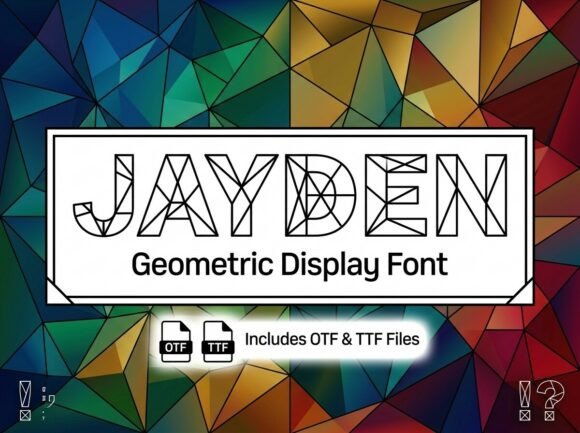
When a design project demands more than just legibility, Jayden steps in as a structural solution rather than a mere decorative choice. This sharp display font captures a sophisticated-and-structural soul that feels less like traditional typography and more like architectural drafting. The letterforms are bold, clean sans-serif shapes meticulously subdivided into intricate triangular and polygonal facets. This unique construction mimics the aesthetic of stained glass or a low-poly architectural blueprint, creating a visual rhythm that commands attention without relying on unnecessary ornamentation.
For designers and brand strategists, Jayden represents a specific intersection of futurism and classical balance. It is not a workhorse text face; it is a headline engine designed to carry weight. Understanding where this typeface thrives requires looking beyond its geometric novelty and examining how its faceted structure solves real-world communication problems in branding, environmental design, and digital media.
Branding for Independent Architecture and Design Firms
The most natural habitat for Jayden is within the built environment industry. Independent architecture firms often struggle to differentiate their visual identity from the sea of minimalist, thin-line sans-serifs that dominate the sector. While those fonts suggest modernity, they rarely convey the tangible reality of construction and material science.
Jayden bridges this gap by embodying the concept of "structure" visually. When used on business cards, project proposals, or site signage, the polygonal subdivisions act as a metaphor for trusses, steel framing, and modular design. For a firm specializing in sustainable urban planning or adaptive reuse projects, this typeface communicates technical precision and forward-thinking engineering before a single word is read. It signals to potential clients that the firm understands form as a calculated assembly of parts, not just an abstract shape.
Consider a boutique interior design studio focusing on brutalist or industrial aesthetics. Using Jayden for their primary logotype creates an immediate alignment between their graphic identity and their spatial philosophy. The font’s balanced weight ensures it remains authoritative on dark backgrounds, while the faceted details provide enough texture to prevent the brand mark from feeling flat or sterile.
Elevating Gallery Exhibits and Cultural Spaces
High-end galleries and museums face a distinct typographic challenge: the title treatment must be striking enough to serve as wayfinding and marketing, yet restrained enough not to compete with the art itself. Jayden offers a compelling solution for contemporary exhibitions, particularly those featuring sculpture, digital art, or immersive installations.
The stained-glass quality of the letterforms interacts beautifully with gallery lighting. In physical spaces, vinyl cutouts of Jayden applied directly to walls cast subtle shadows that change throughout the day, adding a temporal dimension to static text. This makes the typography part of the installation rather than just a label. For exhibition catalogs, the font provides a high-contrast cover title that suggests curation and intellectual rigor. Its geometric complexity pairs exceptionally well with negative space, allowing curators to use massive point sizes without the composition feeling heavy or cluttered.
Futuristic Tech and Digital Product Identity
In the technology sector, specifically within AI, blockchain, and hardware development, brands often seek to visualize concepts that are inherently invisible. How do you represent algorithms, data encryption, or neural networks? Jayden’s low-poly aesthetic serves as a perfect visual proxy for digital complexity.
Unlike rounded, friendly tech fonts that suggest consumer accessibility, Jayden leans into the "black box" nature of advanced technology. It feels computational. A cybersecurity firm using this typeface for their app icon or login screen header immediately establishes a tone of robust protection and complex architecture. The triangular facets can be interpreted as encrypted data blocks or shield plating, reinforcing the product's value proposition through form alone.
For startups in the VR/AR space, Jayden aligns naturally with the wireframe environments users navigate. It creates brand consistency between the marketing materials and the actual user interface of the virtual world. However, this application requires careful handling. Because the font is so distinctly structural, it works best when paired with ultra-clean UI elements. If the interface is already busy with HUD-style graphics, Jayden might add too much visual noise. It shines brightest when acting as the singular anchor of complexity against a sleek, simplified background.
Social Media Headers and High-Impact Minimalism
Digital content creators and influencers operating in niche markets like 3D rendering, motion graphics, or avant-garde fashion need headers that stop the scroll. Standard bold sans-serifs often get lost in the compressed feeds of Instagram or LinkedIn. Jayden’s internal geometry retains clarity even at smaller thumbnail sizes because the contrast isn't just between black and white, but between the solid form and the internal facet lines.
This makes it an exceptional tool for YouTube channel banners or podcast cover art where the title needs to be readable on mobile devices. The rhythmic geometric complexity acts as a texture map, making flat images feel three-dimensional. For a motion designer showcasing their portfolio, using Jayden in the intro sequence or channel art creates a cohesive thread between their static branding and their kinetic work. It tells the audience that the creator thinks in terms of vertices and polygons, establishing professional credibility instantly.
Practical Considerations for Implementation
While Jayden is a powerful asset, its distinctive character demands strategic restraint. Treating it like a standard display font can lead to legibility issues or visual fatigue. Here are practical observations for integrating it effectively:
- Hierarchy is Non-Negotiable: Jayden should almost exclusively be reserved for headlines, logos, and short call-outs. It lacks the x-height consistency and open counters necessary for body copy. Pair it with a neutral grotesque or a refined serif to handle paragraphs. The contrast between Jayden’s complexity and a simple body font amplifies the impact of both.
- Mind the Tracking: The faceted construction creates strong vertical rhythms. Tight tracking can cause the internal geometric lines to collide, creating muddy spots in the letterforms. Slightly looser tracking often enhances the architectural feel, giving each facet room to breathe and maintaining the stained-glass effect.
- Color Application Strategy: Solid fills work well for maximum impact, but gradient fills can either enhance or destroy the design intent. Subtle gradients that follow the facet angles can emphasize the 3D illusion. Random or multi-color gradients often clash with the precise geometry, making the text look chaotic rather than structured. Monochromatic color schemes usually yield the most sophisticated results.
- Background Contrast: Because the font relies on internal subdivision, it requires significant contrast against the background to remain legible. On textured or photographic backgrounds, ensure there is sufficient overlay or blur to prevent the image detail from interfering with the polygonal lines of the letters.
Navigating Limitations and Audience Perception
It is equally important to recognize where Jayden does not belong. Its sharp, engineered aesthetic can read as cold or unapproachable in contexts requiring warmth, empathy, or tradition. Wellness brands, children’s products, heritage food companies, or legal services focused on family law would likely find this typeface counterproductive. The geometric rigidity suggests logic over emotion, which is a strength in tech and architecture but a liability in care-based industries.
Additionally, consider the reproduction medium. While Jayden renders beautifully on screens and in large-format print, fine details may be lost in small-scale embroidery or low-resolution fax/print scenarios. Always test the smallest intended size before finalizing production files. If the facets disappear at 24pt, the font loses its defining characteristic and becomes merely a jagged sans-serif.
Ultimately, Jayden is a tool for storytellers who deal in structure, innovation, and precision. It transforms text into a building block of visual identity, offering a way to construct a modern masterpiece that resonates with audiences who appreciate the beauty of engineered form. By respecting its architectural nature and applying it with intention, designers can leverage this typeface to create brands and experiences that feel as solid and deliberate as the structures they represent.