Donac: Integrating Historical Calligraphy into Modern Design Workflows
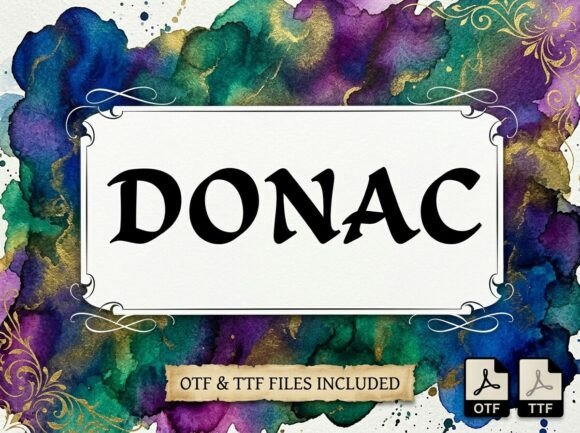
In the landscape of digital typography, finding a typeface that balances historical authenticity with contemporary legibility is a frequent challenge for designers and brand strategists. Donac addresses this specific need by offering a classic calligraphy aesthetic grounded in functional design principles. Unlike decorative scripts that prioritize ornamentation over readability, Donac is engineered with an upright posture and rhythmic weight distribution that mimics the deliberate movement of a traditional flat-nib pen. This structural integrity makes it a viable tool for professionals who require the visual authority of medieval or renaissance letterforms without sacrificing the clarity necessary for modern print and digital media.
Integrating Donac into a creative workflow requires understanding its role as a display typeface rather than a body text solution. Its bold, high-contrast letterforms and sharp terminals are designed to command attention at larger sizes. When planning a project involving heritage branding, luxury packaging, or historical publications, this font serves as the primary visual anchor. It establishes a tone of artisanal prestige and ancient authority immediately, setting the stage for supporting typographic elements. By treating Donac as a strategic asset for hierarchy rather than mere decoration, creators can streamline the decision-making process regarding layout and visual tone early in the project lifecycle.
Strategic Application in Brand Identity and Packaging
For entrepreneurs and marketers developing heritage brands or artisanal products, typography acts as a shorthand for quality and tradition. Donac fits into this ecosystem by providing a chiseled, broad-stroke aesthetic that communicates craftsmanship. When designing labels for spirits, wines, or luxury goods, the font’s sharp terminals and high contrast replicate the look of hand-carved signage or formal diplomas. This association triggers a psychological response in consumers, linking the product to established standards of excellence and time-honored methods.
In practical execution, consider how Donac interacts with physical materials during the production phase. The bold strokes and defined edges of this typeface translate exceptionally well to embossing, foil stamping, and letterpress printing. Because the letterforms possess substantial weight and clear negative space, they maintain their integrity when pressed into textured paper or stamped onto glass. Designers should account for this during the file preparation stage, ensuring stroke widths are sufficient for the chosen manufacturing process. Using Donac in these tactile applications reinforces the "handcrafted" narrative more effectively than digital-only rendering, bridging the gap between screen design and physical product experience.
Pairing and Hierarchy Management
A common pitfall when working with strong calligraphic fonts is creating visual competition within the layout. Donac has a distinct personality that demands breathing room. To maintain efficiency and clarity in your design system, pair it with neutral, low-contrast sans-serifs or clean transitional serifs. The goal is to let Donac handle the emotional heavy lifting while secondary typefaces manage information delivery.
- Establish Scale Ratios: Due to its high contrast, Donac often needs to be set larger than equivalent-weight serif fonts to achieve optical balance. Test sizing at actual print dimensions or 100% zoom during the drafting phase to avoid legibility issues.
- Manage Tracking and Leading: The upright posture of Donac allows for tighter tracking than italicized scripts, but excessive tightening can cause the sharp terminals to clash. Maintain standard or slightly open tracking to preserve the rhythmic flow of the chiseled strokes.
- Limit Usage Scope: Restrict Donac to headlines, logos, drop caps, and short pull quotes. Using it for paragraphs or extended captions dilutes its impact and reduces reading speed. Reserve it for moments where historical emphasis is required.
Technical Implementation Across Digital Platforms
While Donac draws inspiration from pre-digital penmanship, its application is predominantly digital. Ensuring consistent rendering across various platforms is critical for maintaining brand coherence. When implementing this typeface in web environments or digital portfolios, technical considerations must precede aesthetic ones. The sharp terminals and fine hairlines characteristic of broad-nib calligraphy can be vulnerable to pixelation on lower-resolution screens or aggressive hinting algorithms.
To mitigate these risks during web implementation, utilize modern font formats like WOFF2 to ensure crisp rendering while managing load times. When specifying CSS properties, avoid artificial styling such as browser-applied bolding or synthetic italics, as these distort the carefully balanced weight distribution of Donac. Instead, rely solely on the native weights provided in the font family. For responsive design workflows, establish breakpoints where Donac scales appropriately; what looks commanding on a desktop header may become illegible on mobile if not adjusted. In some cases, swapping to a simpler serif for mobile headers while retaining Donac for desktop ensures accessibility without compromising the intended historical atmosphere on larger displays.
Workflow Integration for Publishers and Educators
For professionals in publishing, education, and event planning, Donac offers a solution for projects requiring specific period accuracy or thematic resonance. When designing book covers for historical fiction, fantasy novels, or academic texts on medieval history, this typeface provides immediate genre signaling. However, the integration process extends beyond cover art. Consider using Donac for chapter titles, section breaks, and marginalia to create a cohesive immersive experience throughout the publication.
In educational or museum contexts, where readability is paramount alongside historical flavor, Donac serves as an excellent header font for exhibition panels and interpretive signage. Its upright stance distinguishes it from the slanted scripts often associated with casual handwriting, lending a sense of institutional formality. When preparing files for large-format printing in these environments, verify that the vector outlines are clean and closed. The chiseled nature of the strokes means that any node errors or overlapping paths will be visible at scale. A rigorous pre-flight check is essential to ensure the final output matches the polished precision seen on screen.
Optimizing Creative Output and Quality Control
Adopting a specialized typeface like Donac involves a learning curve regarding spacing and composition. Unlike geometric sans-serifs which are forgiving of minor alignment errors, calligraphic fonts reveal inconsistencies quickly. Developing a standardized checklist for quality control can save time during revisions. This includes verifying baseline alignment, checking for awkward ligatures or terminal collisions, and ensuring sufficient contrast against background colors.
When collaborating with clients or stakeholders who may not be familiar with historical typography, articulate the functional benefits of choosing Donac. Explain that its bold structure ensures visibility and that its upright posture aids scanning speed compared to more ornate alternatives. Framing the selection in terms of user experience and communication efficacy helps justify the stylistic choice during approval phases. Furthermore, maintaining organized asset libraries with preset styles for Donac (e.g., "Header - Large," "Label - Primary") accelerates future projects. This systematic approach transforms a distinctive artistic element into a reliable, repeatable component of your professional toolkit.
The longevity of a design project often depends on the versatility of its core assets. Donac avoids the trap of being overly trendy by rooting its design in centuries-old scribal traditions adapted for modern utility. Whether used for a limited-edition product launch or a permanent institutional identity, its combination of handcrafted beauty and structural discipline ensures it remains effective as trends shift. By focusing on proper pairing, technical optimization, and respectful application, designers can harness the power of timeless penmanship to create work that feels both historically significant and professionally executed.
Ultimately, successful typography is about solving communication problems with appropriate style. Donac solves the problem of conveying heritage, luxury, and authority without resorting to cliché or illegibility. It invites a slower, more deliberate design process that mirrors the craftsmanship it emulates. For the modern creator, this means taking the time to understand the nuances of the letterforms, respecting their historical context, and applying them with technical precision. The result is not just a font applied to a page, but a genuine enhancement of the project's narrative and value proposition.