Amy: Integrating Esoteric Typography into Professional Design
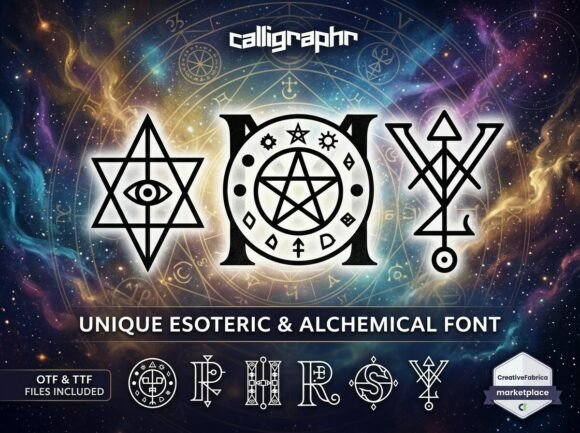
In the competitive landscape of niche branding and independent publishing, typography often serves as the primary vehicle for establishing atmosphere. While standard serif and sans-serif families dominate commercial communication, specific creative sectors require typefaces that carry inherent narrative weight. Amy is a display font designed to meet this precise need, functioning as a visual interface between modern design requirements and ancient mystical aesthetics. Rather than relying on generic horror or fantasy tropes, Amy constructs its letterforms from esoteric sigils, alchemical symbols, and sacred geometry. For designers, authors, and content creators operating within the occult, astrology, or dark fantasy spaces, understanding the practical application of this typeface is essential for maintaining professional credibility while achieving a distinct visual identity.
Deconstructing the Visual Architecture
To evaluate Amy effectively, one must look beyond its novelty and assess its construction as a functional design tool. The typeface does not merely overlay symbols onto standard characters; it integrates them into the skeletal structure of the glyphs themselves. This approach results in a cohesive texture where the boundary between language and iconography blurs. Key visual components include:
- Sigil-Based Construction: Strokes are derived from hermetic and alchemical line work rather than traditional pen nibs or brush strokes, creating a unique rhythm that feels hand-drawn yet systematic.
- Sacred Geometry Integration: Circles, triangles, and intersecting lines form the basis of counters and terminals, grounding the abstract shapes in mathematical precision.
- Delicate Line Weight: Unlike many "witchy" fonts that rely on heavy, distressed textures, Amy maintains a refined, thin stroke. This elegance prevents the design from appearing cartoonish or aggressive, allowing for sophisticated applications.
- Occult Motifs: Pentagrams, celestial alignments, and all-seeing eyes appear as structural elements within specific characters, serving as focal points without overwhelming the overall word shape.
This architectural consistency is what separates Amy from decorative novelty fonts. The designer has prioritized a unified visual system, ensuring that when characters are set together, they create a harmonious pattern rather than a chaotic collection of disparate symbols.
Practical Applications in Niche Markets
The value of a specialized display font lies in its ability to solve specific communication problems. Amy performs best in contexts where the audience already possesses a degree of cultural literacy regarding mysticism and folklore. In these scenarios, the typeface acts as a shibboleth, signaling authenticity to insiders while maintaining aesthetic appeal for general observers.
Independent Fantasy World-Building
For authors and game designers, immersion is paramount. Standard medieval blackletter can sometimes feel cliché or difficult to parse. Amy offers an alternative that suggests magic systems rooted in scholarship and ritual rather than brute force. It is particularly effective for in-world artifacts, spellbook covers, chapter headings, and map legends. The delicate line weight ensures it reproduces well in print at moderate sizes, avoiding the ink bleed issues common with heavier ornamental fonts. However, creators should use it sparingly; it is a seasoning, not a main course. Using Amy for body text will fatigue readers and diminish its impact.
Tarot and Oracle Deck Design
The indie tarot market is saturated, making differentiation critical. Amy aligns naturally with this medium because its source material overlaps with traditional cartomancy symbolism. When used for card titles, numbers, or keywords, the font reinforces the thematic integrity of the deck. Because the characters are built from geometric principles, they pair exceptionally well with linework illustration styles common in modern oracle decks. Designers should test Amy against their specific artwork to ensure the line weights balance correctly; the font’s delicacy requires illustrations that are equally refined rather than bold or painterly.
Gothic Branding and Astrology-Core Social Media
Social media headers and branding assets require immediate legibility alongside atmospheric density. Amy’s distinct silhouette makes it recognizable even at smaller digital resolutions, provided there is sufficient contrast against the background. For astrology-focused accounts, the celestial alignments embedded in the typeface provide instant contextual relevance without requiring additional graphic elements. This efficiency is valuable for freelancers and small business owners who need high-impact visuals without extensive illustration budgets. When using Amy for digital platforms, always verify readability on mobile devices, as intricate details can be lost on low-resolution screens.
Evaluating Usability and Technical Performance
A beautiful concept fails if it cannot be implemented smoothly. From a production standpoint, Amy presents both advantages and considerations that professionals must navigate.
Legibility vs. Atmosphere: As a display font, Amy sacrifices some instantaneous recognition for stylistic expression. It is unsuitable for long-form reading, navigation menus, or critical informational text. Its optimal size range is generally 24pt and above for print, or equivalent pixel dimensions for web. Below this threshold, the intricate intersections of sigils and geometry may merge, creating visual noise.
Pairing Strategies: Amy demands a supportive partner. Because it carries significant visual complexity, it pairs best with clean, neutral typefaces. A geometric sans-serif or a simple humanist serif allows Amy to shine without competition. Avoid pairing it with other decorative, script, or blackletter fonts, as this creates typographic conflict and reduces overall professionalism.
Color and Contrast Sensitivity: The delicate line weight makes Amy sensitive to color choices. Low-contrast combinations (e.g., dark grey on black) will cause the finer details to vanish. High-contrast pairings, such as cream on charcoal or gold on deep indigo, preserve the integrity of the glyph structures. In digital environments, ensure accessibility standards are met, as the ornate nature of the font can reduce perceived contrast even when technical ratios are satisfied.
File Format and Compatibility: Professionals should verify the availability of OpenType features. While Amy is primarily a display face, access to alternate characters or ligatures can significantly enhance customization options, preventing repetitive patterns in longer headlines. Confirming licensing terms for commercial use is also mandatory, especially for products like tarot decks or book covers intended for sale.
Strengths and Limitations Assessment
No typeface is universally applicable. An objective assessment of Amy reveals clear boundaries for its effective use.
Primary Strengths:
- Narrative Depth: It communicates complex themes instantly, reducing the need for explanatory graphics.
- Refined Aesthetic: The delicate weight avoids the amateurish quality often associated with occult typography.
- Versatility Within Niche: Equally suitable for print artifacts, digital branding, and packaging.
- Cohesive System: Characters feel like part of a unified alphabet rather than random clip art.
Notable Limitations:
- Restricted Use Case: Entirely unsuitable for corporate, medical, financial, or general-purpose design.
- Size Sensitivity: Requires careful sizing to maintain detail; not scalable to very small formats.
- Audience Specificity: May alienate or confuse audiences unfamiliar with or opposed to esoteric symbolism.
- Layout Demands: Requires generous whitespace and thoughtful hierarchy to prevent visual clutter.
Determining Fit for Your Project
Deciding whether to incorporate Amy into a workflow depends on project goals and audience expectations. If the objective is to signal authenticity within esoteric, fantasy, or gothic communities, and the application is limited to display purposes, Amy represents a high-value asset. Its sophisticated execution elevates projects above generic alternatives, suggesting a level of care and research that resonates with discerning consumers.
However, if clarity, speed of comprehension, or broad mainstream appeal are primary metrics, Amy is likely counterproductive. Professionals should view it as a specialized instrument in their typographic toolkit—powerful when applied with intention, but ineffective when used as a default. Before committing to Amy, create mockups in the final intended medium and size. Test legibility across devices and print proofs. Solicit feedback from the target demographic to ensure the esoteric references land as intended. When these conditions align, Amy transforms from a mere font into a foundational element of world-building and brand identity, unlocking the secrets of the ancients through the disciplined practice of contemporary typography.