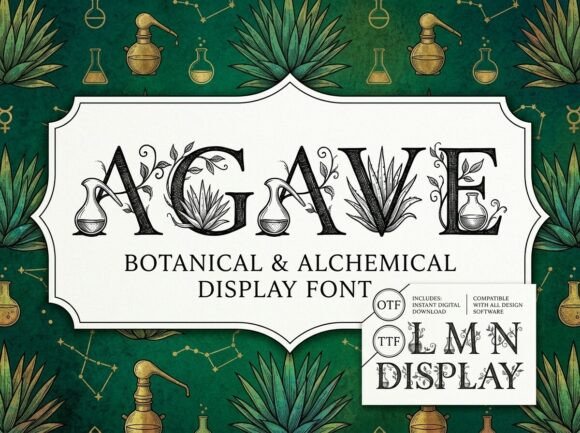
Agave: Botanical Heritage in Display Typography
There is a specific visual language that speaks to the intersection of nature and science, a dialect often lost in modern minimalist design. When a brand needs to convey the weight of history, the precision of botany, and the warmth of artisanal craft simultaneously, standard serif fonts often fall short. They may offer elegance, but they lack narrative. This is where Agave distinguishes itself as more than just a collection of glyphs; it is a storytelling device. Designed with a botanical-and-apothecary soul, this display typeface captures the mystery of heritage through classic letterforms intertwined with hand-drawn flora and alchemical glassware. For designers and business owners navigating the crowded spaces of craft spirits, herbal wellness, and academic illustration, Agave offers a tangible connection to the past that feels authentically rooted rather than artificially distressed.
The Anatomy of Botanical Alchemy
To understand the utility of Agave, one must first appreciate its construction. It avoids the common pitfall of "novelty" fonts where legibility is sacrificed for theme. Instead, it maintains a rhythmic, scientific aesthetic grounded in traditional serif structures. The letterforms themselves possess the sturdy, reliable cadence of 19th-century botanical plates, providing a readable baseline even at smaller display sizes. However, the true character emerges in the details. Hand-drawn agave plants and delicate vines do not merely sit beside the text; they interact with it, creating ligatures and contextual alternates that feel organic rather than applied.
The inclusion of alchemical laboratory elements—retorts, flasks, and distillation apparatuses—anchors the font in a specific historical moment. These are not generic icons but carefully rendered illustrations featuring detailed stippled shading. This texture is crucial. Stippling mimics the engraving techniques used in vintage scientific journals and apothecary labels, adding a layer of tactile depth that flat vector graphics cannot replicate. When you set a headline in Agave, the stippling creates a visual grain that suggests age and manual craftsmanship, instantly signaling to the viewer that the content within is curated, studied, and intentional.
Elevating Craft Tequila and Spirit Branding
The most immediate application for Agave lies in the independent craft tequila and mezcal market. This industry is currently saturated with brands vying for authenticity. Consumers are increasingly educated; they look beyond the bottle shape to the label typography as a marker of quality. A sans-serif geometric font might suggest modernity, but it fails to communicate the generations of jimador knowledge required to harvest the piña. Agave bridges this gap by visually referencing the plant itself and the copper stills used in production.
Consider a limited-edition añejo release. Using Agave for the primary wordmark allows the designer to integrate the agave illustration directly into the brand name, perhaps replacing a crossbar or extending from a terminal. This reduces the need for separate logo marks and creates a cohesive lockup that feels proprietary. On the back label, where space is premium and storytelling is essential, the font’s scientific rhythm pairs beautifully with tasting notes and production data. It treats the liquid inside not just as a party drink, but as an agricultural product with terroir and chemistry. For marketers, this typographic choice reinforces premium pricing and justifies the artisanal positioning against mass-market competitors.
Apothecary Identity and Wellness Aesthetics
Beyond spirits, the apothecary revival in skincare, supplements, and herbal medicine demands typography that balances efficacy with tradition. Modern consumers want products that feel safe and scientifically backed, yet they also crave the romance of pre-industrial healing. Agave serves this dual purpose exceptionally well. The laboratory glassware motifs subtly reinforce the idea of formulation and extraction, suggesting that the product has been carefully compounded. Simultaneously, the botanical vines soften the clinical edge, reminding the user of the natural origins of the ingredients.
For independent formulators and boutique wellness brands, this font solves a significant branding challenge: avoiding the "witchy" stereotype while maintaining mystique. Many herbal brands lean too heavily into mystical aesthetics, which can alienate customers looking for evidence-based results. Agave’s structured, serif-based foundation keeps the design grounded in professionalism. It works particularly well for packaging hierarchy. Use the full illustrative version for the product name on the front of a tincture bottle, then switch to the cleaner base serif for dosage instructions and ingredient lists. This maintains brand consistency without compromising regulatory readability. The stippled texture also reproduces beautifully on uncoated, textured paper stocks commonly used in this sector, enhancing the sensory experience of unboxing.
Digital Headers and Social Media Impact
In digital environments, display typefaces often struggle with screen resolution and scrolling fatigue. Agave’s high-contrast details require careful implementation online, but when used correctly, they create stopping power. For social media headers and Instagram story titles, the font acts as a visual hook. In a feed dominated by bold, flat sans-serifs, the intricate stippling and organic curves of Agave demand attention. It signals long-form content, deep dives, and educational value before the user even reads the caption.
Content creators focusing on botanical illustration, fermentation, or history will find Agave invaluable for establishing a visual signature. It transforms a simple quote card or title slide into a branded asset. However, accessibility remains paramount. Because of the ornate details, Agave should be reserved for large-format headlines and hero images. Never use it for body copy or small UI elements. Pair it with a clean, neutral sans-serif or a highly legible transitional serif for supporting text. This contrast not only ensures WCAG compliance but also makes the decorative elements of Agave pop more effectively. The negative space around the letterforms becomes as important as the strokes themselves, allowing the intricate vines and flasks to breathe on backlit screens.
Practical Considerations for Implementation
Selecting Agave is a commitment to a specific mood, and it requires thoughtful execution to avoid looking kitschy. Here are practical guidelines for integrating this typeface into professional workflows:
- Contextual Awareness: Evaluate the surrounding imagery. Agave pairs best with macro photography of textures (paper, glass, leaves) or line art. It clashes with glossy, high-flash commercial photography or neon color palettes. Ensure your art direction supports the antique-scientific vibe.
- Licensing and Commercial Use: Always verify the specific license tier. If you are designing for a major tequila distributor or a national supplement chain, ensure your license covers the appropriate print runs and digital impressions. Independent creators should check for webfont embedding rights if using it on client sites.
- Spacing and Kerning: Due to the swashes and illustrative elements, automatic tracking can sometimes cause collisions. Manually kern headlines to ensure the vines and glassware nestle comfortably against adjacent letters without overlapping awkwardly. Treat the layout like a garden; give each element room to grow.
- Color Strategy: While black ink on cream paper is the classic presentation, Agave adapts well to muted, earthy tones. Deep greens, oxidized coppers, and sepia enhance the botanical heritage. Avoid bright primaries or neons, which tend to flatten the stippled shading and reduce the perceived dimensionality.
Ultimately, Agave is a tool for specificity. In an era of generic AI-generated imagery and templated design systems, it offers a return to the particular. It reminds us that tequila comes from a spiny succulent, that medicine was once mixed by hand in glass vessels, and that beauty often lies in the precise observation of the natural world. Whether you are launching a new mezcal brand, redesigning a heritage pharmacy, or simply titling a personal botanical journal, this typeface provides the visual vocabulary to honor that lineage. It is not merely decoration; it is a declaration of intent, signaling to your audience that what lies beneath the surface has been cultivated with care, patience, and an enduring respect for the source.