Evaluating Cute Teacher: A Practical Display Font for Educational Design
In the realm of educational design and children’s media, typography serves a function far beyond simple legibility. It acts as a visual cue that establishes tone, age-appropriateness, and engagement levels before a single word is read. For professionals creating resources for early childhood education, primary classrooms, or kid-centric brands, finding a typeface that balances professional polish with genuine playfulness is a recurring challenge. Cute Teacher emerges as a specialized solution to this specific design problem. It is a vibrant, multi-colored display font engineered explicitly for educators, crafters, and designers working within the K-5 demographic.
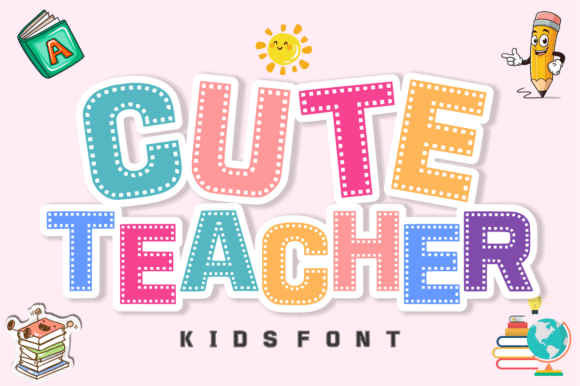
Unlike generic novelty fonts that often sacrifice readability for whimsy, Cute Teacher integrates structural clarity with decorative elements. Its defining characteristic is a unique "stitch" or filmstrip pattern embedded within each glyph, providing a tactile, crafty aesthetic that resonates with both young learners and the adults designing for them. This analysis explores the practical applications, technical strengths, and realistic limitations of incorporating this typeface into professional creative workflows.
Visual Characteristics and Typographic Function
The effectiveness of any educational font lies in its ability to support literacy while maintaining interest. Cute Teacher distinguishes itself through several key design decisions that make it viable for commercial and classroom use:
- Bold Outlined Structure: The heavy stroke weight and clear outlining ensure high contrast against various backgrounds. This is critical for accessibility in early learning materials, where letter recognition is paramount. The bold forms prevent the letters from disappearing when printed on textured paper or viewed on lower-resolution screens.
- Integrated Multi-Color Palette: Rather than relying on post-production coloring, the font includes pre-set color variations. This streamlines the workflow for creators producing flashcards, worksheets, or digital assets, ensuring color consistency across different projects without manual adjustment.
- The Stitch/Filmstrip Motif: This textural detail adds depth without clutter. It evokes associations with handmade crafts, sewing, and classic educational tools, bridging the gap between digital design and physical classroom activities. This subtle texture helps differentiate the font from standard sans-serifs used in corporate or adult-facing communications.
- Playful Yet Controlled Geometry: While the style is informal, the underlying grid remains stable. Letters do not wobble excessively, which maintains a sense of order necessary for instructional materials. This balance prevents the design from feeling chaotic, a common pitfall in juvenile typography.
Practical Applications in Education and Commerce
For entrepreneurs, teachers, and content creators, the value of Cute Teacher is best measured by its versatility across different mediums. The font performs reliably in several high-demand categories:
Classroom Environment and Signage
Physical learning environments benefit significantly from cohesive visual branding. Cute Teacher is optimized for large-format printing, making it an excellent choice for bulletin board headers, door signs, and name tags. The outlined nature of the glyphs allows for easy cutting with Cricut or Silhouette machines, facilitating DIY classroom decor. Because the letters are distinct and chunky, they remain legible from the back of a room, serving functional navigation purposes while reinforcing a welcoming atmosphere.
Educational Resources and Publishing
Creators selling resources on platforms like Teachers Pay Teachers or publishing independent workbooks require assets that signal quality. Using Cute Teacher for titles, section headers, and key vocabulary words creates immediate visual hierarchy. In e-books and interactive PDFs, the font’s brightness draws attention to important concepts without overwhelming the body text. Its association with "teacher life" culture also makes it effective for marketing materials aimed at educators themselves, such as planner covers or professional development workshop flyers.
Merchandise and Personalized Gifts
The font’s crafty aesthetic translates exceptionally well to apparel and stationery. For small business owners producing teacher appreciation gifts, birthday party supplies, or kids' clothing, Cute Teacher offers a ready-made brand identity. The multi-color aspect reduces the need for complex layering in vector software, speeding up production times for custom orders. However, users should verify licensing terms for commercial merchandise to ensure compliance.
Workflow Integration and Technical Considerations
Integrating a decorative display font requires thoughtful execution to maintain professional standards. Based on testing and typical usage scenarios, consider the following operational factors:
- Hierarchy Management: Cute Teacher is strictly a display face. It should never be used for body copy, instructions, or dense paragraphs. Pair it with a clean, rounded sans-serif (such as Quicksand, Varela Round, or Comic Neue) for supporting text. This contrast ensures that the playful header enhances rather than competes with the informational content.
- Color Coordination: Since the font carries its own internal palette, treat it as a primary color source in your design system. Extract hex codes from the font swatches to build complementary backgrounds and accent elements. Avoid introducing clashing neons or overly muted tones that might undermine the font’s inherent vibrancy.
- Print vs. Digital Optimization: For print projects, ensure your file resolution supports the intricate stitch details; 300 DPI is recommended to prevent pixelation in the textured areas. For web and app interfaces, test rendering at smaller sizes. While bold, the internal patterns may moiré or blur on low-pixel-density screens. Use SVG formats where possible to preserve crispness.
- Licensing Awareness: Professional users must distinguish between personal classroom use and commercial product creation. Always review the specific EULA provided with the font file. Many educational fonts have tiered licensing; what is free for a teacher’s bulletin board may require a paid license for a T-shirt sold on Etsy.
Audience Fit and Strategic Value
Not every project requires a thematic display font. Understanding when Cute Teacher adds value versus when it detracts is essential for efficient resource allocation.
Ideal Users: Early childhood educators, elementary school administrators, children’s book illustrators, ed-tech UI designers targeting K-3, and POD sellers in the teacher niche. For these groups, the font solves specific aesthetic and engagement problems that standard libraries cannot address.
Less Suitable Contexts: Secondary education materials, academic research publications, administrative documents, or corporate training modules. In these settings, the playful stitch pattern may inadvertently signal immaturity or lack of seriousness. Professionals working across multiple age demographics should reserve this asset specifically for junior-level projects to maintain appropriate tonal segmentation.
Long-Term Utility and Collection Building
From a collection management perspective, Cute Teacher fills a specific gap between hand-lettered scripts and rigid geometric sans-serifs. Its longevity depends on current trends in educational aesthetics, which currently favor warm, inclusive, and handmade visuals over sterile minimalism. As long as the "cottagecore" and "crafty teacher" movements influence classroom design, this typeface will retain relevance.
However, designers should avoid over-reliance on any single novelty font. Rotate Cute Teacher with other complementary display faces to prevent audience fatigue, especially if you produce content regularly. Think of it as a specialty tool in your kit—highly effective for its intended purpose, but not a universal replacement for foundational typography.
Ultimately, Cute Teacher represents a thoughtful intersection of form and function in educational design. It acknowledges that learning environments are emotional spaces as well as intellectual ones. By providing a typographic voice that is simultaneously structured, colorful, and approachable, it enables creators to produce materials that feel professionally crafted yet authentically connected to the joy of childhood discovery. For those whose work centers on making education accessible and engaging, adding this typeface to their repertoire is a practical investment in better communication.