Alana: Elevating Brand Identity with Vintage Serif Art
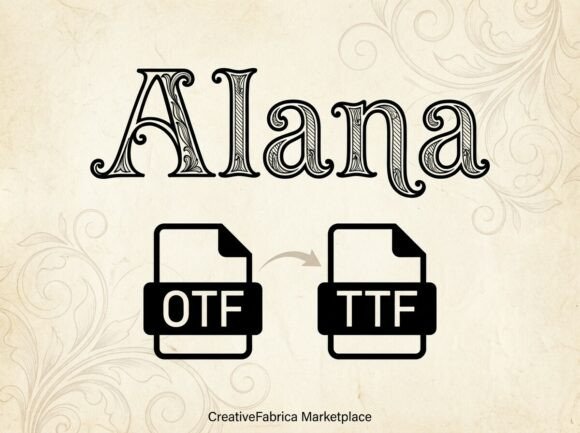
In the crowded landscape of visual communication, typography often serves as the silent ambassador of brand intent. For designers and business owners seeking to convey heritage, luxury, or artisanal quality, standard serif fonts can sometimes feel too sterile or ubiquitous. Alana offers a distinct alternative by functioning less like a utility typeface and more like a collection of illustrative elements. This ornate vintage display serif integrates hand-drawn floral engravings and delicate leaf motifs directly into bold, outlined silhouettes. Understanding how to leverage this specific aesthetic is crucial for professionals who need their typography to carry the same weight as custom illustration.
Bridging the Gap Between Text and Illustration
The primary value proposition of Alana lies in its ability to consolidate two design steps into one. Traditionally, achieving a Victorian-inspired engraved look required selecting a base font and then hiring an illustrator to create custom filigree, or spending hours manipulating vector stock art to fit around letterforms. Alana solves this efficiency problem by embedding the ornamentation within the glyph itself. Each character acts as a self-contained canvas, allowing creators to achieve a high level of visual complexity simply by typing.
This integration supports faster iteration during the branding phase. When mocking up concepts for high-end spirit packaging or boutique cosmetics, time is often a limiting factor. Using Alana allows a designer to present a fully realized, ornate typographic treatment in the initial concept stage without requiring additional asset creation. The result is a more polished presentation that helps stakeholders visualize the final product’s premium nature earlier in the decision-making process. However, users should recognize that this efficiency comes with a trade-off in flexibility; because the flourishes are baked into the font file, they cannot be easily separated or repositioned without advanced vector editing.
Ideal Applications for Ornate Display Typography
While Alana possesses significant artistic merit, its utility is highly context-dependent. It excels in environments where the goal is to signal craftsmanship, history, or exclusivity. Professionals working in the following sectors often find this style particularly effective:
- Craft Spirits and Wine Labeling: The intricate line work mimics traditional copperplate engraving found on heritage bottles, instantly communicating age and quality to consumers browsing a shelf.
- Luxury Packaging and Unboxing Experiences: For jewelry, perfumes, or artisanal chocolates, the font adds tactile visual interest to boxes and tissue paper, reinforcing the perceived value of the contents.
- Editorial and Book Design: Historical fiction, poetry collections, or special edition releases benefit from chapter headers and cover titles that evoke the era of the content.
- Heritage Hospitality Branding: Boutique hotels, tea rooms, and antique shops can use Alana for signage and menus to establish an immersive atmospheric narrative.
In these scenarios, the font does not merely display information; it performs emotional labor. It tells a story of tradition before the viewer reads a single word. For marketers, this means the typography itself becomes a conversion tool, qualifying the audience and setting expectations for a premium price point.
Navigating Legibility and Hierarchy Constraints
A practical consideration when implementing Alana is understanding its limitations regarding readability. As a display serif with heavy internal detailing, it is strictly a headline and short-form text solution. Attempting to use this typeface for body copy, subheads, or small-scale captions will result in illegible clutter. The intricate floral engravings that make the font beautiful at 72pt become visual noise at 12pt.
To maintain professional standards, Alana must be paired thoughtfully with complementary typefaces. A clean, neutral sans-serif or a simple transitional serif works best to ground the composition. This contrast ensures that the ornate elements remain the focal point without overwhelming the viewer. For example, a wine label might use Alana for the varietal name while relying on a legible geometric sans-serif for the alcohol content and tasting notes. This hierarchy preserves the aesthetic impact of Alana while ensuring regulatory compliance and consumer clarity.
Designers should also be mindful of spacing. Because the characters contain external flourishes, default kerning may cause overlapping details that look unintentional rather than artistic. Manual tracking adjustments are often necessary to ensure the negative space between letters feels balanced. Treating each word as a logo lockup rather than a fluid string of text usually yields the most refined results.
Strengthening Brand Authenticity Through Typographic Choice
In an era of digital minimalism, choosing a maximalist, Victorian-inspired typeface is a strategic differentiation tactic. Consumers aged 20–50, particularly millennials and Gen Z, have shown a marked appreciation for "new nostalgia" and tangible craftsmanship. They associate intricate detail with human effort, distinguishing it from AI-generated or template-based design. By utilizing Alana, brands tap into this cultural sentiment, signaling that their products are curated with intention.
This authenticity extends beyond mere aesthetics. For small business owners and freelancers, using such a distinctive font can help level the playing field against larger competitors. While big corporations often rely on safe, proprietary sans-serifs for mass appeal, independent creators can afford to be more expressive. Alana provides a cost-effective way to access bespoke-level styling. Instead of commissioning a $2,000 custom logotype, a business can achieve a similar level of uniqueness through intelligent typographic application. This makes high-impact branding accessible to entrepreneurs operating on lean budgets.
Technical Considerations for Print and Digital
The intricate nature of Alana requires attention to technical output settings. In print production, specifically for packaging and labels, the fine lines of the floral engravings demand high-resolution files and appropriate substrate selection. Printing on textured or uncoated paper may cause ink spread that fills in the delicate details, diminishing the effect. Designers should consult with printers regarding minimum line weights and paper compatibility before finalizing artwork. Embossing or foil stamping can further enhance the Victorian aesthetic, but again, the complexity of the font requires precise die-making to avoid losing definition.
For digital applications, performance and rendering are key factors. Highly detailed serif fonts can have larger file sizes, potentially impacting page load times if used extensively on a website. Furthermore, screen rendering at lower resolutions may alias the fine details. It is generally advisable to use Alana sparingly in web design, perhaps converting headlines to SVG or optimized images to preserve crispness across devices. This approach maintains the visual integrity of the design while adhering to web performance best practices.
Making Informed Decisions About Vintage Aesthetics
Ultimately, selecting Alana should be a deliberate choice aligned with specific project goals rather than a stylistic impulse. Before licensing or downloading, evaluate whether the project truly calls for Victorian gravitas. If the brand voice is modern, tech-forward, or minimalist, this font will create cognitive dissonance. However, if the objective is to evoke warmth, history, and artisanal care, Alana serves as a powerful functional tool.
Users should also compare Alana against other ornamental options to ensure it fits the specific flavor of vintage required. Some display serifs lean toward Art Nouveau curves, while others embrace Gothic rigidity. Alana sits firmly in the Victorian engraving tradition, characterized by botanical precision and structured elegance. Verifying this alignment prevents costly redesigns later in the process. By approaching this typeface with both creative enthusiasm and practical restraint, designers and business owners can unlock its full potential to transform simple text into compelling visual heritage.