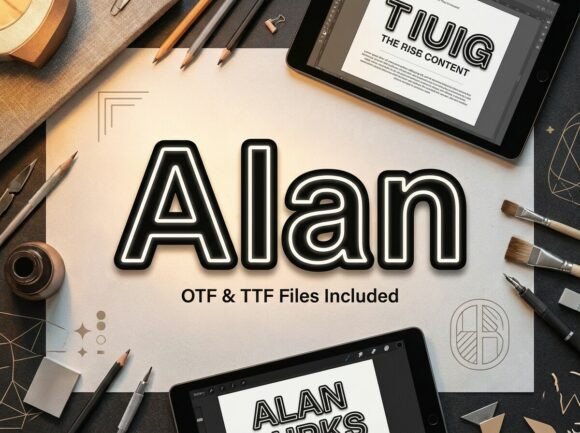
Alan Font: Elegant Serif for Vintage Modern Design
In the vast landscape of digital typography, finding a typeface that feels both historically grounded and distinctly contemporary is a rare achievement. Alan stands out as a sophisticated decorative serif that navigates this balance with remarkable precision. It is not merely a collection of letterforms; it is a design tool characterized by graceful swashes on capital letters and a balanced, high-contrast structure. This specific combination creates a visual rhythm that strikes a perfect chord between professional reliability and artistic expression. For designers, marketers, and creators seeking to infuse their work with vintage charm without sacrificing modern readability, understanding the nuances of Alan is essential for making informed typographic choices.
The Anatomy of Refined Typography
To truly evaluate whether Alan fits a specific project, one must look beyond its general aesthetic and understand its structural DNA. The font’s high-contrast stroke modulation—where thick vertical stems meet razor-thin horizontals—is a hallmark of classical Didone typefaces, yet Alan softens this rigidity with organic fluidity. The swashes are not arbitrary decorations; they serve as directional cues that guide the eye across a layout, adding movement to static designs.
This architectural balance makes Alan particularly effective in display settings. Unlike text-heavy serifs designed for long-form reading at small sizes, Alan demands space to breathe. Its intricate details shine when given ample whitespace, allowing the interplay between positive and negative space to create an air of luxury. For those evaluating typefaces based on quality and presentation, these micro-details are what separate a generic retro font from a versatile design asset capable of anchoring a brand identity.
Perspectives Across Creative Disciplines
Different users approach typography with varying priorities. A freelance graphic designer might prioritize flexibility and commercial viability, while a hobbyist bookbinder may value historical accuracy and tactile beauty. Alan serves these distinct needs in unique ways.
For Brand Strategists and Marketers:
In the realm of luxury goods and premium services, trust is often communicated through visual heritage. Marketers using Alan are typically less concerned with the technical mechanics of kerning and more focused on emotional resonance. The font’s timeless appeal signals established quality, making it ideal for wine labels, high-end skincare packaging, or boutique hotel signage. Here, the priority is commercial value; the typeface acts as a shorthand for sophistication, helping consumers instantly categorize a product as premium before they even read the copy.
For Editorial Designers and Publishers: Book covers and magazine mastheads require a typeface that can carry the weight of a narrative. Editors and art directors evaluate Alan based on its ability to set a tone. The decorative capitals provide built-in hierarchy, allowing designers to create striking title treatments without relying heavily on external illustrations. For this group, creativity and speed are paramount. Having a font that includes integrated stylistic alternates reduces the time spent hunting for complementary ornaments, streamlining the production workflow while maintaining a bespoke appearance.
For Educators and Students: Typography students and educators often use Alan as a case study in contrast and ornamentation. From a learning perspective, it offers practical examples of how to integrate flourishes without compromising legibility. Beginners can analyze how the swashes interact with baseline grids and x-heights, providing tangible lessons in spacing and composition. For educators, the font serves as a bridge between historical type classification and modern application, demonstrating how vintage aesthetics can be adapted for current digital standards.
Evaluating Practical Application and Usability
While aesthetic appreciation is subjective, practical application requires objective criteria. When deciding if Alan is the right tool for your next project, consider how it performs across different mediums and skill levels.
- Versatility in Pairing: Alan’s strong personality means it pairs best with neutral partners. Experienced users know to avoid pairing it with other decorative fonts. Instead, combine it with clean geometric sans-serifs or understated humanist serifs for body text. This ensures the decorative elements remain the focal point without creating visual noise.
- Contextual Appropriateness: Not every vintage-inspired project suits this specific style. Alan leans towards elegance and refinement rather than rustic or distressed nostalgia. If your goal is a gritty, industrial aesthetic, this polished serif may feel too pristine. However, for projects requiring a sense of curated taste, it is unmatched.
- Technical Considerations: Users should verify OpenType feature support in their software. Accessing the full range of swashes and ligatures often requires navigating glyph panels or enabling stylistic sets. Beginners may need to invest time in learning these features, but the payoff in customization is significant.
Balancing Cost, Quality, and Long-Term Value
Investment in typography is rarely just about the initial licensing fee. For small business owners and independent creators, the decision to acquire Alan involves weighing immediate costs against long-term usefulness. A high-quality decorative serif like this offers longevity because it avoids fleeting trends. While ultra-modern display fonts may look dated within two years, Alan’s roots in classical proportion ensure it remains relevant for decades.
Reliability is another critical factor. In professional print environments, ink traps and fine hairlines must reproduce cleanly. Alan’s construction suggests careful attention to these technical constraints, reducing the risk of broken lines on textured paper or low-resolution screens. For entrepreneurs managing their own marketing materials, this reliability translates to fewer revisions and consistent brand presentation across touchpoints.
Making the Right Choice for Your Project
Ultimately, selecting a typeface is an exercise in alignment. You are matching a visual voice to a specific message. Ask yourself what role the typography needs to play. Is it meant to whisper heritage, or shout innovation? Alan excels at the former while accommodating the latter through its crisp execution.
If you are a beginner, start by using Alan strictly for headlines and logos to build confidence in handling decorative forms. If you are a seasoned professional, explore its OpenType capabilities to create custom wordmarks that feel hand-lettered. For business owners, view it as a branding asset that communicates value proposition visually. By understanding both the artistic merits and practical constraints of Alan, you can determine whether this elegant decorative serif is the missing piece in your creative toolkit. The goal is never to use a font simply because it is beautiful, but because it solves a communication problem with grace and intention.