Petunia: Victorian Elegance for Modern Design
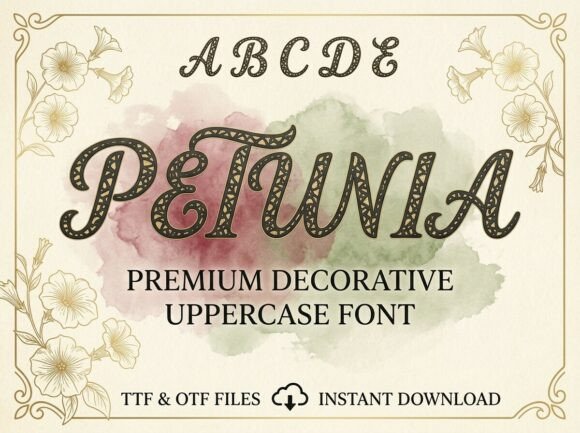
Invite the intricate beauty of a Victorian garden into your creative layouts with Petunia, a premium decorative uppercase font that bridges historical aesthetics and contemporary design needs. This high-detail typeface features elegant, sweeping cursive letterforms that are meticulously filled with a delicate lattice or mosaic texture. Unlike standard script fonts that rely solely on outline strokes, Petunia integrates pattern directly into the glyph structure. With its graceful swashes and rhythmic, swirling terminals, it serves as a specialized tool for designers seeking to evoke craftsmanship without resorting to generic vintage clichés. For professionals managing artisanal apothecary branding, bespoke wedding stationery, independent floral shop identities, or sophisticated editorial headers, understanding the functional application of this typeface is essential for achieving authentic visual communication.
Elevating Brand Identity Through Textural Detail
In an era of minimalist flat design, adding tangible texture to typography creates immediate visual distinction. Petunia transforms uppercase text into a work of hand-crafted art by embedding a mosaic quality within the letterforms themselves. This internal detailing serves a practical purpose beyond mere decoration; it increases the perceived value of the brand material. When a consumer encounters a logo or label featuring this level of intricacy, they subconsciously associate the product with patience, heritage, and artisanal care.
For independent floral shops and botanical brands, this association is critical. The font’s organic, swirling terminals mimic the natural growth patterns of vines and stems, creating a semantic link between the wordmark and the product. However, the true utility lies in the lattice fill. Standard solid black scripts can sometimes feel heavy or aggressive at large display sizes. The openwork texture of Petunia allows background colors or subtle paper grains to show through, reducing visual weight while maintaining presence. This makes it particularly effective for packaging design where ink coverage costs and drying times are considerations, or for digital applications where screen rendering benefits from reduced pixel density in dark areas.
Strategic Applications in Wedding and Event Stationery
Bespoke wedding stationery demands a balance between legibility and ornamentation. Petunia excels here because its decorative elements are structural rather than additive. Designers often struggle with pairing ornate scripts with borders or illustrations, fearing the composition will become cluttered. Because Petunia’s elegance is self-contained within the uppercase characters, it reduces the need for external embellishments like flourishes, frames, or clip art.
This efficiency streamlines the layout process. A simple centered composition using Petunia for the couple's names carries enough visual interest to stand alone on an invitation suite. The rhythmic flow of the swashes guides the eye naturally across the page, establishing a clear hierarchy without requiring bold color contrasts or excessive sizing. For stationers working with letterpress or foil stamping, the defined edges of the mosaic texture provide excellent registration targets, ensuring that the intricate details remain crisp during production. It is important to note, however, that due to this complexity, users should always request physical proofs before finalizing print runs to ensure the lattice detail holds up at the intended point size.
Enhancing Editorial Hierarchy and Readability
Sophisticated editorial headers require typefaces that command attention without exhausting the reader. Petunia functions best as a high-impact display face for titles, drop caps, or pull quotes rather than body copy. Its uppercase-only nature forces a deliberate pacing in editorial layouts, encouraging designers to use it sparingly for maximum effect. When used for magazine mastheads or chapter titles in coffee table books, the font acts as a visual anchor that signals a shift in tone or content.
The benefit for editors and publishers is the establishment of a distinct atmospheric voice. In lifestyle publications focusing on gardening, history, fashion, or wellness, the typeface reinforces the thematic content instantly. Readers recognize the Victorian influence not as a costume, but as a cue for quality and depth. To maintain readability, pair Petunia with a clean, high-x-height serif or sans-serif for body text. The contrast between the intricate display header and the stable body copy creates a professional tension that keeps the layout engaging. Avoid using Petunia in all-caps settings for long phrases; the decorative density becomes overwhelming after three or four words. Reserve it for short, impactful statements where each letter can be appreciated individually.
Practical Considerations for Digital and Print Implementation
While Petunia offers significant aesthetic advantages, successful implementation requires technical awareness. The intricate lattice texture presents specific challenges and opportunities depending on the medium. In digital environments, screen resolution dictates usability. On high-DPI retina displays, the mosaic details render beautifully, adding richness to web headers and social media graphics. However, on lower-resolution screens or when scaled down significantly, the internal texture may alias or blur, compromising legibility.
Designers should test Petunia across multiple viewport sizes before deploying it in responsive web designs. It is often safer to use this typeface in static hero images or SVG formats where scaling is controlled, rather than relying on live CSS text rendering for small viewports. For print applications, the opposite consideration applies. The fine lines of the lattice require sufficient ink trap and paper quality. Uncoated papers with high absorbency may cause the delicate internal patterns to bleed, filling in the negative space. Coated stocks or smooth uncoated options generally preserve the integrity of the mosaic fill best.
- Scale Appropriately: Maintain a minimum point size (typically 24pt+ for print, 48px+ for web) to ensure the internal lattice remains distinct and does not merge into a solid mass.
- Mind the Spacing: The sweeping swashes and terminals require generous tracking and leading. Tight kerning will cause the decorative elements to collide, destroying the rhythmic flow that defines the typeface.
- Color Contrast Matters: While the texture adds depth, low-contrast color combinations can make the lattice indistinguishable. Ensure sufficient tonal difference between the type and background to maintain accessibility standards.
- Limit Usage Scope: Treat Petunia as a spice, not the main ingredient. Use it for primary headlines or logos only, never for subheads, captions, or functional UI text.
Assessing Fit: When to Choose Alternatives
Understanding when not to use Petunia is as valuable as knowing its strengths. This typeface is inherently stylistic and period-evocative. It is ill-suited for corporate tech branding, medical communications, financial services, or any context requiring neutrality and modernist clarity. If the project goal is to convey speed, innovation, or institutional authority, the Victorian ornamentation of Petunia will create cognitive dissonance and undermine the message.
Additionally, consider the audience's age and cultural context. While the target demographic of 20–50-year-olds generally appreciates neo-Victorian aesthetics as a form of nostalgic luxury, older demographics may find the decorative density difficult to read, and younger Gen Z audiences might perceive it as dated if not styled with contemporary supporting elements. Always evaluate Petunia against the specific emotional response required by the brief. If the goal is approachable warmth or casual friendliness, a simpler hand-lettered script may serve better. Petunia shines specifically when the objective is refined elegance, historical resonance, and artisanal prestige.
Ultimately, Petunia is more than a decorative asset; it is a strategic design element that solves the problem of conveying luxury and craft in a saturated visual market. By integrating texture directly into the typographic form, it saves designers from complex layering effects while delivering a cohesive, high-end aesthetic. Whether defining the identity of a boutique apothecary or setting the tone for an editorial feature, this typeface offers a practical pathway to transforming standard text into meaningful visual art. Success lies in respecting its constraints: giving it space to breathe, ensuring technical fidelity across media, and pairing it with complementary elements that allow its intricate beauty to enhance, rather than dominate, the overall composition.